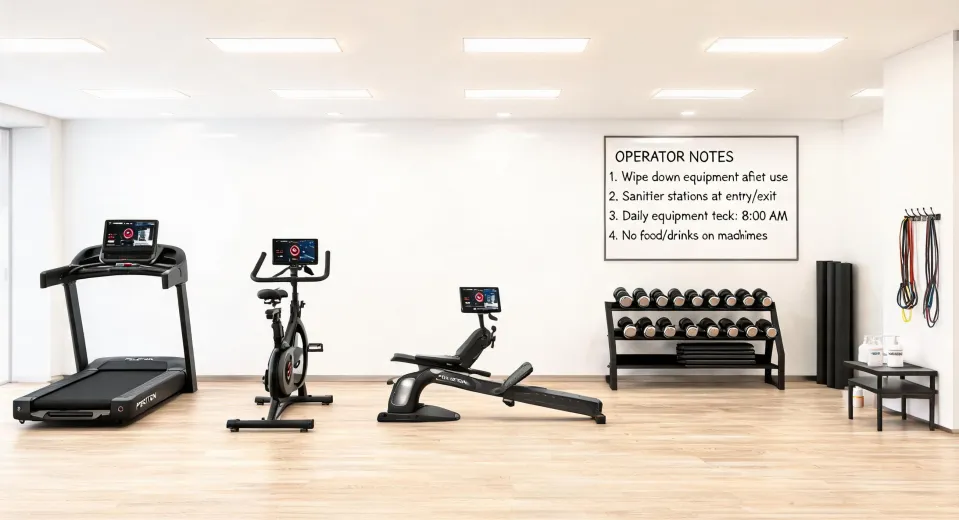
Last spring, I got a call from a regional facilities director. They'd just spent $180,000 on a fitness floor for a 350-room hotel: two Peloton bikes, a treadmill, an indoor rowing machine, a wall of dumbbells, and a few benches. Six months later, the average daily workout count was under four. He asked me if the room was too small. It wasn't. It was the assumption that great equipment equals a great workout experience.
Sound familiar? If you're buying connected fitness for a hotel, corporate gym, or multifamily building, you're probably starting with the wrong question. As a brand compliance manager for a commercial fitness supplier, I review every installation before it goes live—roughly 120 facilities a year. In 2025, I've rejected 22% of first deliveries. The reason is almost never the hardware. It's the missing ecosystem.
The Surface Problem: Nobody Uses It
A guest walks into a beautifully designed fitness room, sees a row of expensive machines, touches a screen, and steps back out. Why? There are a hundred possible reasons: no login instructions, no class schedule, no clear starting point. The machine itself isn't the barrier. The absence of a guided experience is.
The Deeper Problem: Hardware Without Programming
What I mean is that connected fitness is not a bicycle; it is a subscription to motivation. A Peloton bike is only as good as the Peloton workout programs tied to it. The live schedule, the class library, the instructor roster, the stats that follow you across sessions—that's what builds the habit. A screen and a flywheel are just hardware.
This is why 'pilates Peloton' is such a common search. People aren't looking for a bike. They're asking whether the same platform can run a Pilates session, a mobility workout, or a 20-minute stretch. That's a programming question, not a hardware question. The answer you should get is not 'we have a bike.' It's 'here is how the class library supports that movement style.'
Take the indoor rowing machine. It is one of the best full-body cardio tools in a commercial gym. But if nobody teaches the stroke, it will sit untouched. Rowing is technical: drive with the legs, swing the back, pull with the arms. A connected rower with on-screen coaching can make it approachable. But your procurement contract needs to specify the training content that comes with it. Otherwise you are buying a metal frame and a flywheel.
At the other end of the spectrum is the Cubii under desk elliptical. It is compact, quiet, and shows up in office wellness conversations. In a multifamily residence, it seems like a low-risk amenity. But I audited a corporate site that ordered 20 Cubii units and added no digital programming around them. A year later, they were gathering dust. The product is not bad. The absence of an experience is the problem.
Similarly, when someone searches 'what are kettlebell swings,' they are not asking for a machine. They are asking for instruction. If your fitness room has kettlebells but no one has ever taught the movement, they stay on the rack. Your spec should include instructional content—live classes, video tutorials, or a platform's strength programs.
The question everyone asks in procurement is 'what is the most impressive piece of equipment we can show off?' The question they should ask is 'how will this equipment get used six months from now?' That is the difference between a showroom and a fitness center.
The Cost of Getting It Wrong
Let's put a number on the broader cost. In our Q3 2024 quality audit, 31% of newly opened commercial fitness centers we inspected had at least one 'hero' piece of equipment that a guest could not use on day one—screen offline, account not logged in, or a pending software update. None of those failures appeared in the vendor's proposal. All of them were visible to the guest. That is not a maintenance issue; it is a broken brand promise.
Looking back at one of my earlier projects, I should have pushed for a twelve-week launch plan before the purchase order went out. At the time, the equipment spec seemed enough. It was not. If I could redo that decision, I would include onboarding scripts, staff training, and a content calendar in every contract. That is not 'nice to have.' It is the product.
A common response I hear: 'We just want to open the gym; the management company will handle the rest.' In my experience, that is like accepting a shipment without verifying the voltage. Management companies change. Staff turn over. The equipment stays. If you do not specify the experience at the purchase stage, you cannot blame the operator later.
The Solution: Buy Outcomes, Not Machines
The fix is not a bigger budget. It is a different evaluation lens.
- Choose equipment with an embedded programming layer—like Peloton's full suite of studio classes, strength, rowing, and restorative content.
- Specify account setup and network authentication as deliverables, not afterthoughts.
- Plan for ongoing engagement: monthly class updates, instructor-led challenges, and resident communication.
And if any vendor makes a health or performance claim—'burns calories fast,' 'tones in 10 minutes'—ask them to substantiate it. Per FTC guidelines (ftc.gov), advertising claims must be truthful, not misleading, and backed by evidence. I've rejected vendor brochures that gave calorie-burn numbers with no testing protocol behind them. Add that to your quality gate.
What you are really delivering is not a machine. It is a reason to return.
The fundamentals have not changed: people want to move, sweat, and leave feeling better. What has changed is how they expect to get there. By 2025, a fitness room is not a collection of machines; it is a connected, guided experience.
Start with the experience. The machine is just the tool.