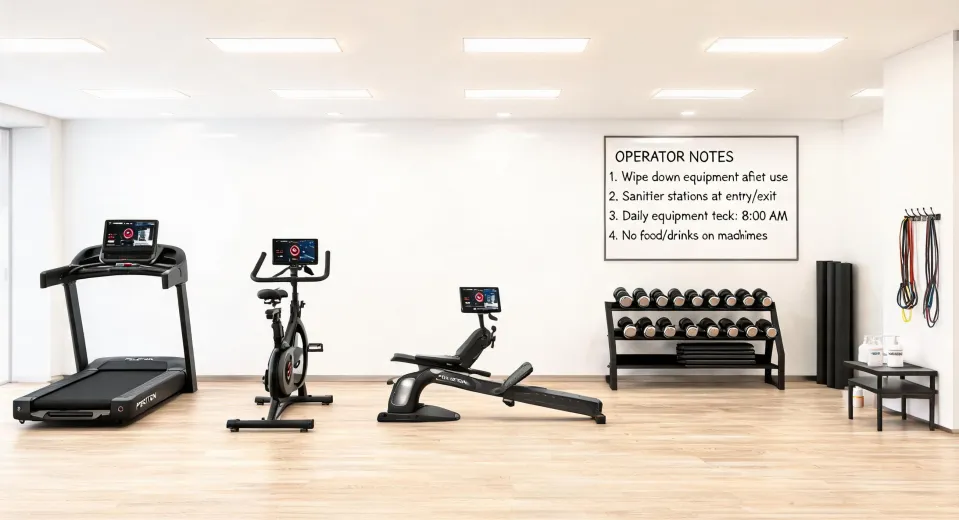
I got the call in late January 2025, from a hotel general manager whose project we had lost nine months earlier. The property wasn’t far from the Peloton NYC studio, and the owner had wanted a fitness floor that felt like that experience: high-energy cycle classes, a serious strength zone, and the kind of audio setup that makes a guest feel like the instructor is in the room with them.
We bid on the work. We lost. The winning bid came in about $7,000 lower than ours, and the hotel’s purchasing person saw that number and stopped reading. I understood it at the time. In a budget review, $7,000 is $7,000.
This is not a story about how another vendor undercut us. This is a story about what happens when a quote says one thing and nobody checks what actually gets installed. I’m a quality compliance manager at a commercial fitness outfitting company. I review roughly 30–40 fitness rooms per year before clients accept them. What I found in that hotel gym, in a single afternoon, turned into a $47,400 retrofit.
Why the room looked beautiful at first
The fitness floor was on the 23rd floor, with floor-to-ceiling windows facing west. It looked impressive. The hotel manager opened the door and said, “See? It’s not that bad.” And it wasn’t, if you only looked at the surfaces.
But within about 30 seconds, I noticed that the three bikes in the cycle zone didn’t look right. They were big, dark, and aggressive. They also had fan cages on the front. That was the first clue.
The purchase order had described them as “spin bikes, class-compatible.” What had been delivered were air bikes. That is not a small distinction.
Air bike vs spin bike: it’s not a style choice
The air bike vs spin bike confusion is more common than it should be. In a hotel gym, the difference matters because the training experience is completely different.
- Air bikes use a large fan blade for resistance. The harder you push, the more air you move, and the resistance rises exponentially. They also have moving handlebars, so your upper body is involved in every stroke. They’re excellent for interval conditioning, but they are not designed for studio-style cycle classes.
- Spin bikes have a weighted flywheel and a more road-like geometry. The resistance is steady and repeatable. That’s what allows riders to follow a coached class: when the instructor says “climb at resistance 45,” a spin bike gives you a consistent scale and a stable platform to stand on.
On an air bike, the class instructions don’t translate. Cadence gets unstable. Resistance is not measurable in the same way. The whole point of the hotel’s cycle zone was to let guests join a digital class without leaving the building. On those air bikes, they could pedal along, sure. But it was not the class experience the owner had approved.
I don’t think the vendor set out to deceive anyone. I think they saw the words “indoor cycling” and assumed an air bike would pass as equivalent. That is precisely why vague line items are dangerous.
The shoulder press with dumbbells test
The second issue took me a little longer to find. That’s the one that could have hurt someone.
On the strength side of the room, under a low section of ceiling, the vendor had placed an adjustable bench and a dumbbell rack. It looked fine from across the room. But when I stood under that soffit and ran through a straightforward movement—a seated shoulder press with dumbbells—my hands cleared the ceiling by less than two inches at the top of the lift.
I’m 5’10”. A taller guest, moving quickly, doing a shoulder press with dumbbells at the end of a hard set, would not have that same margin. If they push the dumbbells up a little too aggressively, they hit the concrete soffit. That’s how you get a jammed wrist, a dropped weight, or a damaged ceiling.
This is one of those details that doesn’t show up in a price comparison. The original quote said “one dumbbell station, with bench.” It didn’t account for the actual structural clearance in that part of the room.
Coincidentally, we didn’t have a formal overhead clearance check on our checklist back in 2022. Then a client called us after a near miss in a corporate gym we had installed. After that incident, I made a rule: every strength zone gets an overhead movement test before handover. If you can’t complete a full shoulder press with dumbbells without hitting the ceiling, the station doesn’t pass.
The Bose noise cancelling earbuds that weren’t
There was also a smaller problem, but it’s worth mentioning because it shows how costs get cut invisibly.
The hotel wanted a small audio library at the front desk, so guests could borrow earbuds during a class. In our spec, we had listed Bose noise cancelling earbuds for that station. Not because of the logo—because the mechanical room sits directly behind the fitness floor, and the low-frequency hum from the HVAC is exactly the kind of noise that active noise cancellation is good at removing.
What the hotel received was a box of generic earbuds in a plastic tray. The packaging said “noise cancelling,” but it wasn’t. The HVAC hum came straight through, so guests kept pushing the volume higher. It wasn’t a safety issue the way the ceiling clearance was, but it degraded the class experience every single day.
The vendor saved maybe $40 per unit. It was one line in a long quote. But it was a visible clue that the entire bid had been engineered to a budget instead of a standard.
Peloton support answered the question in 20 minutes
At one point, the general manager looked at the air bikes and asked me, “Can’t we just connect them? Isn’t that an add-on or something?”
I told him it wasn’t my call to make. I suggested he call Peloton support directly and ask whether those bikes could deliver the digital class experience he had promised to his guests. He called right there in the bike room and put the phone on speaker.
Peloton support didn’t try to sell him anything on that first call. They listened to the scenario, explained that the class experience relied on equipment that could properly connect to the digital ecosystem, and then transferred him to their commercial and hospitality team. That team sent an email the same day with the equipment and account requirements.
The contrast was uncomfortable. The original equipment vendor had not responded to the hotel’s last three emails. Peloton support responded in under an hour. That tells you everything about who was standing behind the product.
The real invoice
By the time we finished the full audit, the scope of the fix was clear. The air bikes had to go back. The strength zone needed to be reconfigured so guests could actually use the dumbbell area safely. The earbuds needed to be replaced with the Bose noise cancelling earbuds that had been specified in the original design. And the equipment placement needed to be redone by people who understood how the room was going to be used.
The hotel paid us $47,400 to correct it. On top of the $31,700 they had already paid the first vendor. The room they had initially tried to build for $31,700 ended up costing more than $79,000, and it still had to be closed for two weeks during the renovation.
Our original proposal, the one that lost, was $38,900.
I’m not telling this story to say our quote was better. I’m telling it because the only reason that hotel spent $79,000 is that somebody read “spin bike” and assumed it meant something specific. The quote didn’t include model numbers. It didn’t define the class experience. It didn’t say what was excluded.
What I learned about transparent quotes
It took me years and a lot of inspected gym floors to understand this: in commercial equipment, the price is never the first thing to compare. The specification is. A quote that lists exact model numbers, exact quantities, and exact exclusions is doing you a favor. A quote that says “class-compatible” without saying which bike, or “noise cancelling” without saying which brand, is not comparable to anything.
These days, when a client says a competitor’s price is lower, I ask to see the line items. If the competitor’s quote is genuinely transparent, fine. If it’s vague on the equipment models, I tell the client: ask them what’s not included before you ask them to lower the price again.
(Should mention: this story is a few months old now. The hotel’s fitness floor is back open, the cycle classes are full, and the GM has stopped telling people he saved money on the original bid.)
Air bikes are not bad machines. They’re just not spin bikes. Vague language is the actual problem.