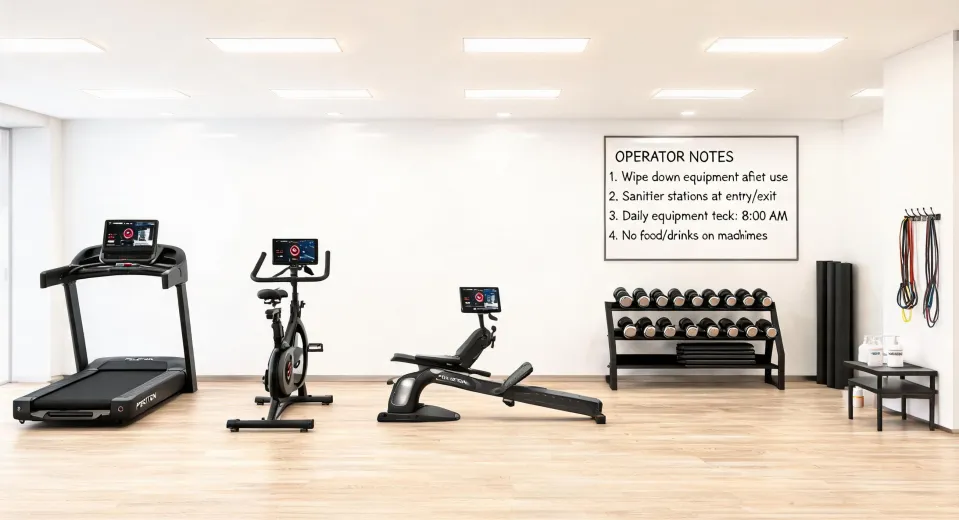
If you are adding Peloton to a hotel, apartment, or corporate gym, order Peloton stationary bikes first and treat a Peloton treadmill as a separate project with its own delivery and service plan. That is not a fitness argument. It is a procurement argument, and it cost me about $4,600 in avoidable mistakes before I understood it.
By day, I handle connected-fitness equipment orders for a hospitality group that runs hotel and corporate fitness floors. I’ve been doing this for eight years, and I’ve personally made—and documented—11 significant mistakes totaling roughly $46,000 in wasted budget. I keep that list visible in our office so the next person doesn’t repeat it. This is the mistake that still bothers me.
The order that changed my checklist
The order happened in January 2023. Or maybe early February—I'd have to check the purchase order to get the exact week. I approved one Peloton Tread and two Peloton stationary bikes for a 1,900-square-foot amenity gym in a residential building. My thinking was simple: the treadmill is the showpiece, so buy it first and get the bikes as supporting equipment.
I did what a lot of first-time buyers do. I typed “peloton treadmill near me” into a search engine to see what local availability looked like. What came back were nearby hotels, apartment complexes, and health clubs that already had the machine. Not our empty gym. At the time, I didn’t see that as a warning. But it was one: when people search for a Peloton treadmill near them, they aren’t looking for a treadmill. They are looking for a place that has one and keeps it working.
The Peloton stationary bikes arrived first. They moved through the loading area and into the gym with no drama. They were set up, connected, and tested in less than half a day. Guests started using them almost immediately. Then the treadmill arrived, and everything went sideways.
The delivery crew flagged an issue with the route from the service elevator to the fitness floor. It wasn’t about weight as much as turning radius. What worked on a floor plan did not work in a real hallway. We had to reschedule the delivery, pay extra for the second attempt, and delay the opening timeline by three weeks. I still kick myself for not walking the route before signing the purchase order.
Then, a few weeks after installation, the Tread reported an error. It wasn’t something I could fix. The nearest Peloton-certified service provider was about 90 miles away, and the wait was brutal. We had a beautiful treadmill sitting in the middle of the floor, dark, roped off, and useless.
“The bike is what guests ask about. The treadmill is what makes them search for you.”
That line is now written at the top of our procurement checklist. I don’t mean people don’t want the Tread. They do. But in a shared facility, the machine you can maintain consistently is more valuable than the machine that only looks impressive in a brochure.
What I learned about guest search behavior
While the Tread was waiting for service, I saw a guest try to use one of the machines in the cardio corner. She was standing on an elliptical, watching a Peloton class on her phone, and she looked confused. Finally, she typed into her phone: “how do you run on an elliptical machine?”
It sounds funny, but it wasn’t a dumb question. The instructor kept saying “run intervals,” and this guest was trying to follow along on a machine that doesn’t let you run. Her feet never left the pedals. Her body was doing something, but it wasn’t running. She wasn’t clueless—the space around her was clueless. We had given her digital content that pointed to a machine we didn’t have available.
That moment changed how I think about connected fitness equipment. The hardware matters less than the workflow around it. The Peloton app, classes, and instructor community are powerful, but they work best when the physical equipment matches what the content asks someone to do.
Strength training taught me the same lesson
Another surprise came from our guest search logs. I expected cardio-related searches. That’s what I bought, so that’s what I noticed. Instead, there was a steady stream of strength questions like “bent over row barbell.”
I don’t have exact search volumes in front of me, and I’d be guessing if I gave you numbers. But it happened often enough that I wrote it down. Guests weren’t searching for where to buy a barbell. They were searching for form guidance. They had done a strength class, heard the instructor say “bent over row,” and then wanted to check whether they were doing it safely.
So I made two changes. First, I added a full-length mirror on the strength wall. Second, I put a laminated card next to it with a QR code linked to a two-minute form demo for the bent over row barbell. It isn’t a high-tech solution, but it answered the question people were already asking.
The same pattern shows up outside the gym. We once added a connected entertainment setup in the resident lounge, and the first support question we got was about “ps5 bluetooth headphones.” It is easy to roll your eyes at that phrase. But it’s the same lesson: if you install a connected device and leave no explanation, you haven’t finished the job. You’ve created a support ticket. Whether it’s a Peloton stationary bike, a treadmill, or a gaming console, the amenity is only as good as the instructions and service plan behind it.
The checklist I use now
I don’t want this to sound like a textbook answer. This is just the list I wish someone had forced me to read in January 2023:
- Walk the actual delivery route from the loading dock to the workout floor before ordering. Measure doors, elevators, hallways, and turning radius.
- Ask for the local service radius in writing before you sign. If something breaks, who comes, and how long will it take?
- Match the content to the hardware. Don’t put a treadmill-focused class library in a room where the only running machine is a broken treadmill.
- Plan for the 9 p.m. question. Write down the answers to common searches like “ps5 bluetooth headphones” or “how do you run on an elliptical machine?” before residents or guests ask them.
- Consider square-foot ROI. In my experience, a row of Peloton stationary bikes brings more guest satisfaction per square foot than one oversized treadmill that might be out of service for weeks.
I have mixed feelings about the Peloton Tread in shared fitness spaces. On one hand, when it works, it’s an incredible amenity. Guests love it, and it creates the kind of experience that makes people type “peloton treadmill near me” and choose your property. On the other hand, it demands more from the building, the team, and the budget than people expect. It isn’t a mistake to buy it. It’s a mistake to buy it casually.
When I would give the opposite advice
I don’t want to tell you that the treadmill should always come second. If you already have a commercial service plan, a freight elevator, and a clear delivery route, a Peloton Tread can absolutely be the anchor amenity that makes your space stand out. My point is not that the bike is better. It’s that the bike is less likely to fail in the first ninety days.
This is also not a recommendation to skip Peloton’s commercial guidance or to make decisions based only on a blog post. I’d rather spend ten minutes explaining service logistics than deal with a mismatched purchase order later. An informed buyer asks better questions and makes faster decisions. I learned that the hard way, and the invoice was painful enough that I’m still sharing it.