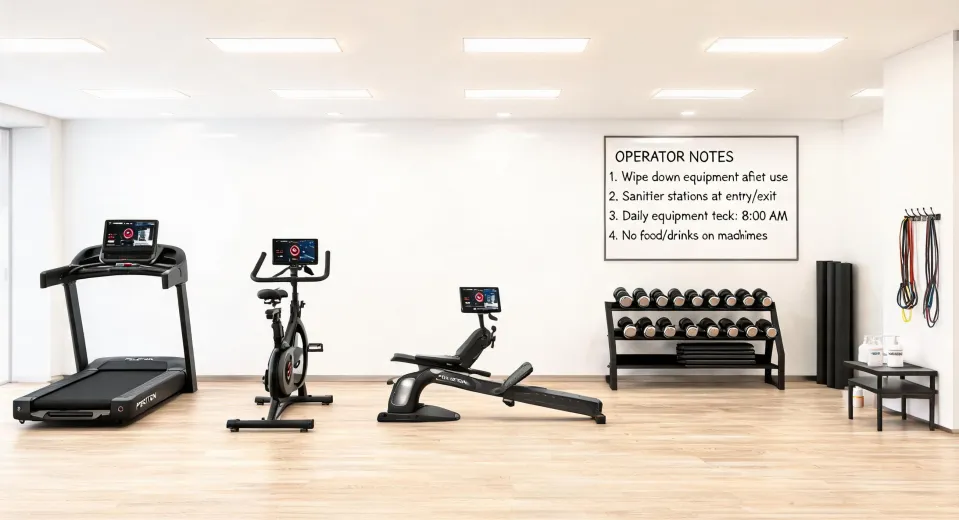
Last January I stood in a half-finished hotel gym in Phoenix with a clipboard, a tape measure, and a cost spreadsheet that was already two versions out of date. The developer wanted a Q3 opening. I needed to furnish the fitness floor without blowing the FF&E budget or creating problems for a night staff that already had a long list of things to do.
For context, I am a procurement manager at a 14-property hospitality company. I have managed our fitness equipment budget—roughly $180,000 per year—for the past six years. I also keep a detailed spreadsheet that tracks every purchase order, vendor promise, and warranty claim. That sounds boring, but it saved us when the connected fitness equipment debate started.
The original spec listed two spin bikes, one treadmill, a functional trainer, a set of dumbbells, and an empty wall. The empty wall invited a lot of opinions. Someone wanted a Peloton bike. Someone else wanted a cheaper bike with a tablet bracket. A third person said guests don’t care about screens. That was true about ten years ago, back when a tablet bolted to a bike was a novelty. Today, guests arrive at a hotel gym expecting an experience close to what they have at home—including the option of using their own Peloton login and class history.
The myx fitness bike vs Peloton rabbit hole
Because I care about money, I typed the obvious question into a search engine: myx fitness bike vs Peloton. I went back and forth between the two options for about two weeks. The cheaper bike had a lower upfront price, and the monthly platform fee was lower. On paper, it was the practical buy.
But something felt off. I could not tell whether the support structure was built for a commercial property. That is not a brand loyalty argument; it is a segmentation argument. Myx is generally a consumer product, while Peloton has a B2B side. When I checked Peloton’s B2B site (business.peloton.com, accessed May 2024), it clearly listed account management, custom setup, and commercial service support. Those features do not show up in a typical consumer review.
I almost ignored my gut because the Peloton quote was higher. Good thing I did not. Five cheaper bikes would have saved roughly $12,000 upfront. But I would have spent about $2,300 on custom mounts, commercial WiFi certificates, network configuration, and the IT time needed to manage consumer devices. That gap is invisible when you compare sticker prices.
Let me be careful: I am not saying every lower-cost option is wrong for every use case. In a home, a lower-cost connected bike can be perfectly fine. In a hotel, the real question is what you do on day 40 when a guest complains about a resistance knob or a screen that disconnected from the network. Peloton’s commercial structure was the answer we needed on this project.
The Peloton login thing is bigger than it sounds
Our operations team asked the question that almost got lost in the hardware comparison: “Can guests use their own Peloton login?” The short answer is yes, but the longer answer depends on how the machine is configured. On the unit we tested, we could set it up so a member signs in with their own account and sees their history. We could also leave it in guest mode. The important part is that you have to choose before the equipment is placed in the room.
I sat with a Peloton support representative for twenty minutes, mostly because I wanted someone to be accountable for the answer. At the time, that felt like over-verification. Later, the front desk handled two Peloton login questions in the first hour after the gym opened. If we had not documented the flow, those two guests would have had a frustrating first experience, and a support ticket would have landed on the IT team. Five minutes of prevention saved us five days of correction.
The content library was not just marketing
Once I accepted that the hardware is only half the product, I started testing the workout library—something I never imagined doing as a procurement manager. I wanted to know whether a guest who walked into the gym with only a pair of dumbbells could still find a relevant class. In one test, a 15-minute upper-body class included an overhead dumbbell press section and a dumbbell tricep finisher. That may not sound impressive. But a lot of fitness content assumes a full rack of equipment, and a hotel gym usually has a 5-to-50-pound dumbbell rack, not a full studio.
The class library made it fairly easy to pull up a workout that matched the room. The overhead dumbbell press cueing was clear. The dumbbell tricep work was appropriate for someone who wanted to stay away from machines. That matters when the guest is the one deciding whether to come back to the gym the next morning. After the test, I added content-matching to our procurement checklist.
Can Beats headphones be tracked? That was the wrong question
The brand standards team asked whether we should stock premium headphones in the gym. Then came the exact question: can Beats headphones be tracked? I read through Apple’s Find My documentation (as of May 2024) and answered, “Some newer models can show up in Find My if they are paired with an iPhone.” Then I realized we were asking the wrong question.
We were not going to pair every headphone to a managed iPhone, and no hotel front desk has time to chase a lost pair around a property. Find My is built for an individual consumer, not for a hotel gym. I was trying to solve a theft problem before defining the bigger problem: premium headphones are consumables in a public amenity space.
We bought 12 pairs. After six months, seven were still available. That might sound like bad math, but it was a useful budget line. If someone asks you what to source for a hotel gym, set the expectation early: budget for replacement, label the headphones visibly, check them during the daily gym walkthrough, and do not treat them like capital assets.
What I would tell another buyer
At the end of the project, I built a 12-point connected fitness procurement checklist. I won’t list all 12 here, but the points I almost missed were these:
- Confirm who answers commercial support calls before you sign the order.
- Walk through the member and guest login flows using the exact model you plan to buy.
- Make sure the class library matches your dumbbell range and floor layout.
- Treat accessories like replacement inventory, not trackable assets.
- Ask for a total installed cost that includes delivery, removal of old equipment, and network setup.
That five-minute verification list has become the cheapest insurance in our budget. The myx fitness bike vs Peloton decision ended with Peloton for this project, but not because of brand hype. It ended because Peloton had a commercial support model, member login flexibility, and content that actually works in a room with dumbbells and a little patience.
The Phoenix hotel opened on schedule. The Peloton login instructions were posted just inside the bike room, the dumbbells were in order, and no one called me in the first week with a broken screen. That is not a guarantee for every property. It is just the outcome of doing the boring checks before spending the money.