Why There's No Single Right Answer
I've been reviewing facility equipment for over four years now. Every quarter, someone on our team asks me the same question: "What should we put in our corporate fitness room?" or "What's the best setup for the employee lounge?"
And every time, my answer starts the same way: it depends on who's using the space and what they expect from it.
That's not me dodging the question. It's genuinely the most honest starting point. I've seen $18,000 worth of premium equipment sit mostly unused in a break room because it didn't match how employees actually spent their time there. I've also seen a modest setup outperform expectations because it fit the space perfectly.
So instead of giving you one blanket recommendation, here's how I'd break it down into three scenarios—and how to figure out which one you're in.
Scenario A: High-End Wellness Centers and Hospitality Gyms
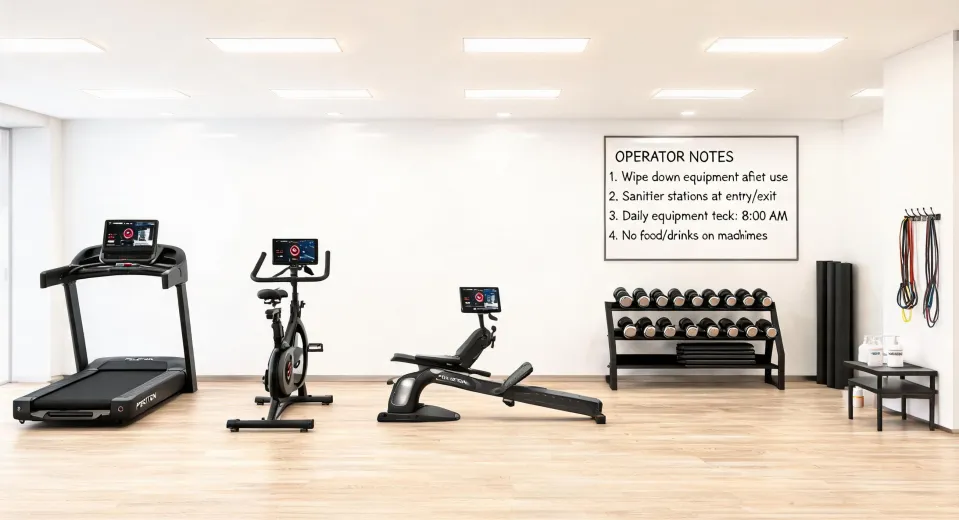
This is the scenario where Peloton equipment makes the most sense. When you're outfitting a hotel fitness center, a premium apartment complex gym, or a corporate wellness space where usage is high and expectations are even higher, the Peloton ecosystem delivers something that cheaper alternatives struggle to match: a complete experience.
A Peloton indoor cycling setup isn't just a bike with a screen. It's the live studio classes, the instructor community, the leaderboard, the whole thing. For a hotel guest who uses Peloton at home, seeing one in the fitness center is a signal: this place gets it.
But here's where I see buyers get tripped up. They focus on the hardware specs and skip the operational reality.
Take the Peloton treadmill weight—and I mean both the unit's physical weight and its user weight capacity. A commercial-grade treadmill can weigh 300+ lbs. If you're installing on an upper floor, you need to verify floor load ratings. I learned that one the hard way: we assumed a standard commercial space could handle anything we put in it. Didn't verify. Turned out the structural assessment flagged it, and we had to delay installation by three weeks while we got engineering sign-off.
Those three weeks cost us the client's launch window. They weren't happy. (Note to self: always loop in facilities engineering before spec-ing heavy equipment.)
For this scenario, my rough budget guide:
- Peloton Bike: ~$1,445 (plus $44/mo subscription per unit, based on Peloton's published pricing as of early 2025; verify current rates)
- Peloton Tread: ~$2,995+
- Installation and setup: $200–500 per unit depending on location
The subscription cost is the part people forget to budget. On 10 bikes, that's $5,280 per year in ongoing fees. Not a dealbreaker, but it needs to be in the total cost picture from day one.
Scenario B: Employee Lounges and Recreation Spaces
Different space, different priorities. A break room or recreation area isn't trying to replicate a premium gym experience. It's trying to give people a reason to step away from their desks and recharge.
Here, I'd actually push back on the instinct to buy Peloton everything. That's a common assumption failure I've seen—leadership says "we want the best," so procurement defaults to the most recognizable brand. But a Peloton Bike in a casual lounge where nobody's tracking their output metrics? That's a $1,500 coat rack.
What works better in this context:
- Video game art and interactive displays—these draw people in for short sessions
- Comfortable seating with integrated charging
- Audio equipment that's easy to use without instruction
Speaking of audio—this is where I've seen the most quality complaints. Those cozy band headphones that look great in product photos? The ones with the plush headband and soft ear cushions? They're comfortable for about six months. Then the padding compresses, the headband loses tension, and you're replacing them.
We saved about $40 per unit buying budget headphones instead of commercial-grade options. Ended up replacing the entire batch within 14 months. On 50 units, that $2,000 in "savings" turned into $4,500 in replacements plus the labor to swap them out.
And the most common question we get from staff: "why is my headset not working?" Nine times out of ten, it's a cable issue or a pairing problem—both of which are far more common on cheap units. Commercial-grade headphones with replaceable cables and better Bluetooth chipsets cost more upfront but generate fewer support tickets.
Scenario C: Compact Multi-Use Rooms
This is the trickiest scenario because you're trying to do more with less. A single room that needs to function as a stretch space, a meditation corner, and maybe a light cardio area.
Here's my contrarian take: in this scenario, skip the premium connected equipment entirely. A Peloton needs dedicated space, reliable Wi-Fi, and a user who understands the ecosystem. In a multi-use room, it becomes an obstacle.
What I'd recommend instead:
- Wall-mounted functional trainers or resistance systems
- Folding cardio equipment (rowers or compact bikes)
- A dedicated audio zone with quality speakers—not headphones
The surprise here wasn't that cheaper equipment worked fine. It was that a mid-tier audio setup consistently outperformed the premium headphone approach for group use. People in shared spaces don't want to wear headphones (which, honestly, should have been obvious). They want ambient sound or nothing.
How to Figure Out Which Scenario You're In
Ask yourself three questions:
- Who's the primary user? If it's external guests or high-paying tenants, lean toward Scenario A. If it's internal employees on break, Scenario B. If it's a mix with limited space, Scenario C.
- What's the usage pattern? Structured workouts (Scenario A), casual short sessions (Scenario B), or flexible ad-hoc use (Scenario C)?
- What's your tolerance for ongoing costs? Peloton subscriptions, maintenance contracts, and replacement cycles add up. If you need predictable annual spend, factor that in before committing.
Bottom line: the most expensive option isn't automatically the best, and the cheapest will almost never be the most cost-effective. Look at the total cost of ownership over three years—equipment, installation, subscriptions, maintenance, and expected replacement cycles. The lowest quote on paper rarely wins that calculation.
Pricing referenced in this article is based on publicly available vendor information as of early 2025. Verify current pricing and specifications before purchasing.