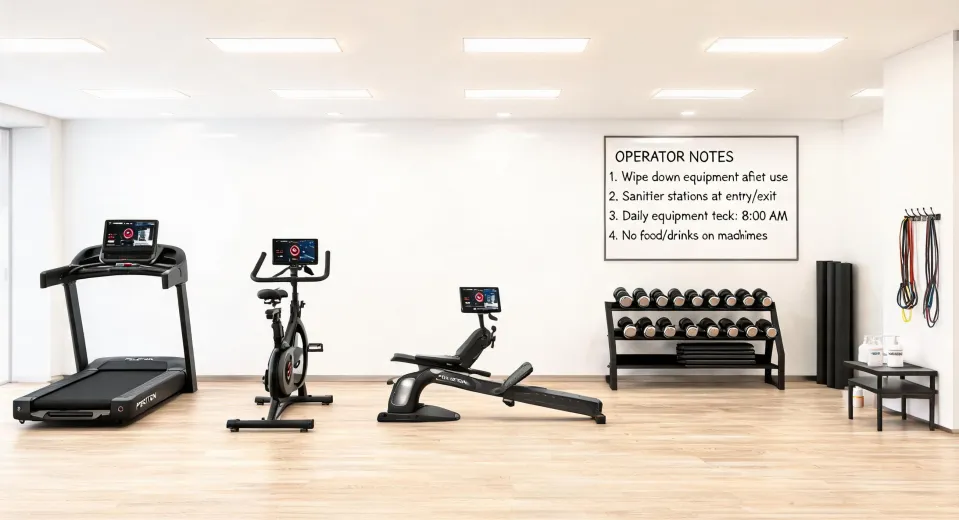
When people find out I review fitness equipment compliance for a living, the first question is almost always: "So, what's actually worth buying?"
I'm a quality compliance manager at a hospitality equipment supply company. I inspect roughly 40-60 equipment deliveries bound for hotel fitness centers and corporate wellness rooms across the Southeast—every single one before it reaches a property. I've rejected about 15% of first deliveries in 2024 so far. Belt tension off, display calibration errors, frame welds that didn't meet spec. Brand name didn't matter at inspection time.
Over the last two years, the question from clients has shifted. It's no longer "which treadmill should we buy?" It's "Peloton only, or should we assemble our own equipment mix?"
So here's a real comparison. Two philosophies for outfitting a premium fitness space:
- Option A: The Peloton Ecosystem—connected bikes, treadmills, rowers, and strength programming through the Peloton app, all under one vendor.
- Option B: The Assembled Mix—a home gym mirror for strength, a treadmill from one manufacturer, kettlebells from another, each component picked piece by piece.
I'll measure both across five dimensions: content, hardware quality, strength training capability, operational complexity, and the limits of each approach. Full disclosure: I have preferences. But I'll hold both options to the same standard.
1. Content Ecosystem
This is where Peloton separates from the field fast.
If you've never watched a guest use the Peloton app login on a hotel treadmill, here's what happens: they tap the screen, scan a QR code, log into their own account, and suddenly they're looking at thousands of live and on-demand classes. Their stats, their history, their milestones. No re-learning your system. No confusion about which app goes with which machine.
That familiarity matters more than most operators realize. When I audit guest satisfaction at properties, the highest-rated fitness amenities share one trait: they're instantly usable. A guest on a business trip wants to walk into a gym and know exactly what to press. A fragmented mix—mirror app on one machine, a treadmill console from a different vendor, a rower with no digital connection—creates friction nobody wants at 6 AM.
What I mean by "friction" is the total experience cost: the guest who can't access their workout library, the member who has to create yet another account, the front desk staff who don't know how to troubleshoot three different systems. Consistency isn't a minor feature. It's the entire thing.
Verdict: Peloton wins this dimension hands down. An ecosystem can't be replicated by a pile of disconnected screens.
2. Hardware Quality and Spec Compliance
Here's where I have to talk about failures, because that's the job.
A vendor failure in March 2023 changed how I think about equipment choices. We received a batch of twelve treadmills for a corporate wellness center, and three had visible belt alignment issues—4 to 6 millimeters of drift at full speed. Normal tolerance is under 2. The vendor claimed it was "within industry standard." It wasn't. ASTM F2276, the standard for fitness equipment safety and performance, doesn't give you that much slack. We rejected the batch and made them redo it at their cost. Now every contract includes belt-alignment certification.
Peloton isn't immune to defects—no manufacturer is. But their documented tolerances, warranty terms, and supply chain consistency are tighter than most brands at similar price points. When I run a blind comparison with our maintenance staff, they most often identify the Peloton unit as "more solid" without knowing which was which. The frame feels denser. The console mount is sturdier. The fit-and-finish is measurably better.
Verdict: Peloton leads on consistency. Both approaches can meet minimum specs, but you'll see the difference at inspection.
3. The Strength Training Gap: Peloton Kettlebell Classes vs. Real Kettlebells
Now the counterintuitive one.
Peloton offers peloton kettlebell classes through their app. The coaching is excellent. But here's the honest gap: those classes require actual kettlebells on site. Peloton doesn't sell them. The app clearly lists household equipment requirements, but the platform's strength content is built for bodyweight, dumbbells, and basic implements—not a comprehensive strength program.
That's an expertise boundary I respect. Peloton doesn't pretend to be a complete strength training solution. They focus on cardio and class variety, and they say so.
A home gym mirror takes the opposite approach. It's built for strength, mobility, and form-focused work. But it's not a cardio machine. It's not a rower. It's a screen with a camera and resistance programming—excellent at what it does, limited in range.
So if your property's fitness center needs to deliver serious strength offerings, a mix is better. Peloton for cardio, plus a mirror and a kettlebell rack for strength. But if your guests primarily want cardio with enough bodyweight strength options to stay consistent, Peloton covers the basics.
Verdict: No blowout in either direction. The "all-in-one" claim has limits—and vendors who admit it earn my trust for everything else.
4. Operational Complexity and Staff Training
Facility staff turnover is constant. Training new people is a hidden cost nobody budgets for at the beginning.
With a Peloton-only room, staff training is minimal. The console interface is identical across every machine. One of our property managers told me her equipment training manual dropped from 18 pages to 6 when they standardized. That's 12 fewer pages of "how to use treadmill" instructions, resistance tips, and troubleshooting flowcharts.
The assembled approach multiplies complexity. Different consoles, different login systems, different support contacts, firmware updates on different schedules.
We didn't have a formal equipment onboarding process for the first year and a half. Cost us when a new hire accidentally put a $4,000 treadmill into factory demo mode during a VIP site visit and couldn't exit. The third time a guest-facing firmware glitch happened on a non-Peloton machine, I finally created a standardized equipment training protocol. Should have done that in week one.
Verdict: Peloton simplifies operations dramatically. If you don't have a dedicated equipment manager, this alone is reason to standardize.
5. The Coverage Gap Nobody Wants to Address
Neither approach covers the full amenity picture.
Hotel wellness isn't just the gym. It's the pool deck, the walking trails, the family recreation areas. I've reviewed playground compliance too—and an outdoor slide has safety surfacing requirements, material specs, and load ratings that have nothing to do with connected fitness. Peloton doesn't address that. Neither does a home gym mirror. Different standards, different vendors, different expertise entirely.
Smart operators accept this. A fitness equipment provider is a specialist, not a general amenity contractor. The moment you expect your connected fitness vendor to solve outdoor recreation compliance, you're asking the wrong question. The same logic applies in reverse: your playground vendor shouldn't be sizing up your treadmill specs either.
Verdict: Both approaches have hard boundaries. Recognizing them early prevents mid-project surprises.
So, Which Should You Choose?
Here's my practical guidance.
Choose the Peloton ecosystem when:
- Your property positions itself as premium and tech-forward.
- Guest experience and brand consistency matter more than equipment floor variety.
- You want one vendor contact for support, warranty, and training.
- Your staff aren't dedicated fitness equipment specialists.
Choose the assembled mix when:
- Strength training is a primary draw for your fitness center.
- Your budget needs distribution across multiple equipment priorities.
- You're replacing pieces of an existing gym rather than starting fresh.
- You have a team member who owns equipment maintenance as part of their role.
Looking back, I should have pushed for standardized equipment specifications earlier. At the time, it felt like I was limiting options for properties with different needs. But the audit data told a different story: the properties with the lowest maintenance costs, the fewest guest complaints, and the best satisfaction scores all had one thing in common—consistent equipment standards.
Bottom line: an all-in-one approach is easier to maintain but not a universal fitness solution. A mix gives you flexibility but demands more operational attention. There's no free lunch. There's just the choice that fits how you actually operate. In my experience, the best equipment decision isn't the one with the best marketing—it's the one you can actually support.