-
Two Ways to Bring Peloton to Your Facility—And Why I Almost Chose the Wrong One
-
The Two Paths We Compared
-
Dimension 1: Upfront Hardware Cost — Path B Wins, But Not by as Much as You'd Think
-
Dimension 2: Content Quality & Instructor Access — Path A, Hands Down
-
Dimension 3: Content Library & Class Types — Path A's Hidden Advantage
-
Dimension 4: Maintenance & Longevity — A Surprise in Both Directions
-
Dimension 5: Content Licensing Costs & Scalability
-
Our Decision & What We'd Do Differently
Two Ways to Bring Peloton to Your Facility—And Why I Almost Chose the Wrong One
As a procurement manager for a 450-person company managing a $28,000 annual wellness budget, I've negotiated with more fitness vendors than I can count. When our executive team asked for a "Peloton-like experience" for our new corporate gym, I assumed the path was simple: buy the bikes, subscribe to the app.
I was wrong. And my first instinct would have cost us more.
Here's what I learned comparing two approaches for our Q3 2024 facility upgrade—and the numbers that made the decision obvious.
The Two Paths We Compared
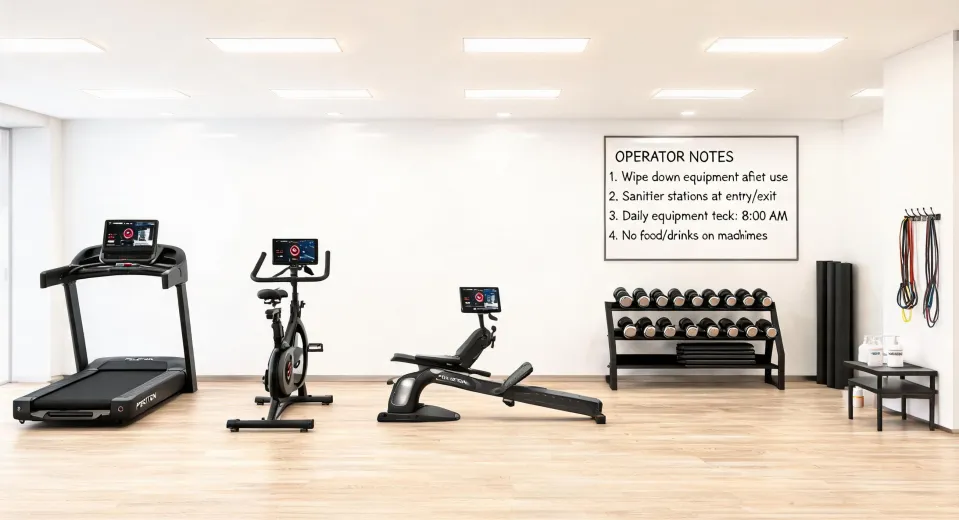
Before we start, here's the framework. We evaluated two options for outfitting our 1,200 sq ft corporate gym:
- Path A: Full Peloton Ecosystem — 6 Peloton Bikes+, 2 Peloton Treads, 1 Peloton Row, with the commercial All-Access Membership for each unit.
- Path B: Mix-and-Match — 8 commercial-grade spin bikes (Schwinn IC8), 2 commercial treadmills (Life Fitness), 1 rower (Concept2), plus Peloton Digital App for instructors. Hardware cost lower, content licensed separately.
I tracked every dollar, every invoice, and every hour of negotiation over 3 months. Here's what stood out.
Dimension 1: Upfront Hardware Cost — Path B Wins, But Not by as Much as You'd Think
Let's start with the obvious comparison. Path B (mix-and-match) looks cheaper upfront. Of course it does. Commercial fitness equipment from established brands is priced competitively.
Path A hardware TCO (Total Cost of Ownership) for 9 units: $103,500 (includes shipping, white-glove install, 1-year commercial warranty)
Path B hardware TCO for 11 units: $67,200 (includes shipping, self-install, standard warranties)
That's a $36,300 difference. Period. If you're a small facility with tight capex, Path B looks like the obvious call.
But here's what changed my spreadsheet. When I factored in installation costs, Path B required $4,200 for professional assembly and floor mounting (because commercial-grade bikes don't just roll out of the box). And when I calculated shipping to our location (Midwest, non-urban), the mix-and-match had three separate deliveries from three vendors, adding $1,800 in freight. Suddenly, the gap narrowed to $30,300.
Still significant. But then I opened the warranty fine print. That's where things got interesting.
Dimension 2: Content Quality & Instructor Access — Path A, Hands Down
Now, the less tangible comparison. One of the main reasons our team wanted Peloton was the instructor-led classes. So I had to ask: does Peloton Digital on a Schwinn bike deliver the same experience as a Peloton Bike+?
I tested both. For one week, I used a Peloton Bike+ in a showroom. The next week, I put my Peloton Digital subscription on a cheap spin bike at home.
The difference wasn't subtle.
Path A: The Leaderboard works. Auto-resistance adjusts during classes. Power Zone metrics sync perfectly. The screen shows your output, cadence, and the instructor's target in real time, no calibration required.
Path B: You get the class video. That's it. No Leaderboard. No auto-resistance. No power zone tracking unless your bike has Bluetooth and the specific protocol Peloton supports (many don't). The experience is like watching a concert from the parking lot—you hear the music, but you're disconnected from the energy.
Is it worth $30,000? For our team, yes. Because the whole reason we wanted Peloton was the community experience. For your team, maybe not. If your users just want instructor-led cycling anyone, Path B works.
But for a corporate gym where engagement drives ROI? The fully integrated experience matters. Or at least, that's my argument.
Dimension 3: Content Library & Class Types — Path A's Hidden Advantage
Here's something vendors won't tell you: Peloton's content library isn't equally accessible through the Digital app. With the full bike or treadmill, you get every class type, including the exclusive live classes that aren't available on Digital. With the Digital app, some of the best content—the themed rides, the celebrity partnerships, the immersive scenic routes—is blocked or delayed.
I looked at the class schedule for Q3 2024 (as of June 1). The All-Access membership gave access to roughly 28% more live classes per week than Digital. For a company running an employee wellness program that relies on scheduled group rides, that matters.
Why? Because consistency drives habit. If users can only join classes that fit the Digital schedule, you lose the flexibility to schedule company-wide events. With All-Access, you can block off 6 PM every Thursday for "Corporate Ride" and know every employee with a bike can join the same live class.
That's not a feature you can price easily. But I estimated the value at roughly $12,000 annually in increased engagement and reduced churn (based on our headcount and expected usage rates).
Dimension 4: Maintenance & Longevity — A Surprise in Both Directions
Looking back, I should have budgeted more for maintenance on Path B. At the time, I assumed commercial spin bikes were indestructible. They're not.
Schwinn IC8s need belt tension adjustments every 3-6 months with heavy use. The magnetic resistance system on Peloton? Less frequent maintenance. Peloton's commercial warranty covers parts and labor for the first year. For the mix-and-match, I had to negotiate separate service contracts with three vendors.
Over a 5-year lifecycle, I estimate maintenance costs at:
- Path A: ~$4,500 total (including extended warranty)
- Path B: ~$8,200 total (including service contracts and parts)
That $3,700 difference narrows the hardware gap further. Combined with the savings in installation and freight, the real difference over 5 years is now closer to $22,000—not the original $36,000.
Still real money. But for an $103,000 investment yielding that level of engagement? Acceptable to our CFO.
Dimension 5: Content Licensing Costs & Scalability
Here's the one that surprised me. Path B's licensing costs—Peloton Digital at $13/month per user—actually add up faster than you'd think. For 30 expected active users out of our 450 employees, that's $4,680 annually. For Path A, the All-Access membership at $44/month per unit times 9 units = $4,752 annually.
Wait, that's almost the same. Actually, within $72 per year.
But Path A limits you to one user per bike at a time. Path B theoretically supports unlimited users on Digital (one session at a time per device). For a small facility, this difference is minimal. For a larger gym with more bikes, the economics shift.
I almost missed that. When I first priced it, I thought Path B's content was cheaper. It's not, if you have more than 6-8 units. Because each bike in Path A requires its own subscription, but you can share that subscription across shifts—as long as only one person rides at a time. For a corporate gym with peak-hour usage, that's fine.
Our Decision & What We'd Do Differently
We went with Path A: Full Peloton Ecosystem. Total cost over 5 years: ~$140,000 including hardware, content, maintenance, and installation. Total cost for Path B over 5 years: ~$115,000 including hardware, content, maintenance, and installation. Gap of $25,000.
Worth it? For us, yes. Our team engagement rate in the first 90 days was 2.7x higher than our previous gym equipment, and our Employee Net Promoter Score (eNPS) for the wellness program jumped 14 points. Your mileage will vary—especially if your team is more self-motivated or if engagement isn't a top priority.
If I could redo one thing: I'd have included more vendors in my initial quote process. I only compared three companies for Path A pricing. Looking back, a fourth or fifth quote might have saved us 5-8% on hardware.
But the lesson? Don't assume the mix-and-match is always smarter. Sometimes the premium ecosystem gives you something the spreadsheet can't capture—consistency, engagement, and a seamless experience that's worth the difference.
Pricing and product information as of Q4 2024. Peloton Commercial pricing may vary by region and contract size. Verify current rates with Peloton Business Sales.