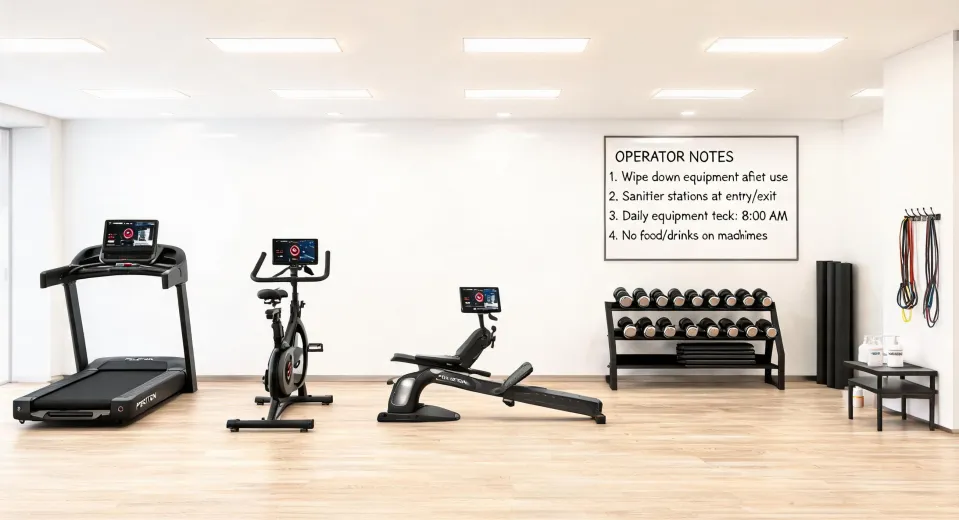
So your company wants to 'prioritize wellness.' Translation: you get to buy a bunch of fitness equipment and hope people actually use it. I've been managing purchasing for a mid-size company—about 400 employees across three offices, maybe 350? Let me think... we're around 400 now, give or take. Anyway, in that time I've ordered everything from a Peloton Bike to budget kettlebells. And I've made plenty of mistakes along the way.
The biggest one? Assuming there's a single 'best' setup. There isn't. The right choice depends on your space, your workforce, and your budget. If you're about to start this process, here's a framework based on three common scenarios.
Scenario 1: You Have a Dedicated Fitness Room
If you're lucky enough to have a proper gym room, the classic recommendation actually works: get a connected bike or treadmill. Peloton is still the brand people ask for by name. We bought a Peloton Bike in 2023, and honestly, the waitlist for it during lunch is a legit thing.
But there's a catch you might not know: the Peloton Rower is cancelled. They stopped selling it after a safety recall in May 2024. So if anyone on the leadership team says 'let's get a rower too,' you'll have to source that separately. My first instinct was to order a WaterRower as a substitute. I told our vendor rep 'we need a rower for the gym.' They heard 'WaterRower.' I didn't realize until the delivery schedule showed up—we both said 'rower' but meant completely different machines. To be fair, the WaterRower isn't a bad machine—but it doesn't sync with Peloton's app, which kind of defeated the purpose for our members.
Lesson: verify specs before ordering. If you're going with connected cardio, I'd suggest one Peloton Bike and one treadmill (the Peloton Tread is quieter than I expected). For strength, go with Kettlebell Kings. Their powder-coated kettlebells cost more, but they hold up in a shared space. We initially bought cheap cast-iron ones, and after six months the handles looked rusted and terrible. That doesn't exactly send a great message to employees.
Also, if you're planning a gym room, leave extra space for stretching mats. We didn't, and the room always felt cramped. A wall-mounted TV for on-demand classes is also a must—we initially used an old tablet propped against a shelf, and nobody could see it. Small fixes, but they made a huge difference in usage.
One more thing: when we painted the motivational quote on the gym wall, our design team used Pantone 286 C for the logo. The CMYK conversion took a bit of tweaking, but the printer got it right at 300 DPI. Details matter—even the color of your gym looks like a reflection of the company brand.
Scenario 2: You Only Have a Corner or Spare Room
You're in the majority. You've got maybe 150 square feet, a concrete floor, and someone's old couch. The usual advice—'just get a Peloton'—isn't great here. A bike takes up 4x6 feet, and unless you have a dedicated area, it becomes a coat rack.
Here's the counterintuitive suggestion: skip the bike and buy a walking treadmill under desk. I went back and forth between a spin bike and an under-desk treadmill for two weeks. The bike was flashier and multiple employees said they wanted it. But every study I read about office wellness suggested people are more likely to use a walk pad for short sessions than a bike for a 30-minute class. So we tried one. Turns out, the under-desk treadmill gets used way more than our office's Peloton ever did at the previous location.
When buying a walking treadmill, don't cheap out. I made that mistake—bought a $200 one, and it burned out after three months. The second one (a mid-range Urevo) has survived over a year. If you want something more premium, look for models with a higher weight limit and a quieter motor. And set up a simple approval process for these purchases. When I forgot ours, an unauthorized rush fee showed up on the invoice. We didn't have a formal approval chain for that order, and guess who got stuck with the $150? Yep, me.
For strength in a small space, I'd still recommend Kettlebell Kings. A 20-pound and a 35-pound bell cover most needs, and they look professional sitting in the corner. Definitely better than a full squat rack that nobody uses.
Scenario 3: Your Team Is Remote or Hybrid
If most of your employees work from home at least half the week, you don't need equipment in the office. You need a digital subscription and a few home accessories. I'd go with Peloton Digital—the app-only tier—because it gives people live and on-demand classes without requiring them to buy a $2,000 bike.
For home equipment, keep it simple: a mat, some resistance bands, and maybe a single kettlebell. But the thing that surprised me most in our employee survey was headphones. People didn't want more equipment; they wanted headphones that stayed comfortable during a 45-minute class. I looked into the Peloton Urbanears Sumpan headphones—they're decent, and they were on sale, so I bought a batch. Honestly, they're not the most amazing pair I've ever tested, but they work fine with the Peloton app.
Then came the support tickets. The top question? 'How to connect Bluetooth headphones.' I'd say 80% of those issues were people not realizing they needed to pair the headphones with their phone first, then in the Peloton app go to Settings → Equipment → Audio. I put together a one-page cheat sheet, and the tickets stopped.
Also, don't ask about the Peloton rower for remote employees. It's cancelled. If your team really wants a rower, they can buy a Concept2—but syncing it with Peloton's app isn't perfect. Take this with a grain of salt; I'm not deep in the Peloton ecosystem, just an admin who orders stuff.
How to Tell Which Scenario You're In
The easiest way to figure this out:
- Do you have a dedicated room that can fit a bike, a treadmill, and floor space for kettlebells? Go with Scenario 1.
- Is the 'gym' space also a conference room or storage area? Lean toward Scenario 2.
- Do more than half your team work remotely at least twice a week? Scenario 3 is your best bet.
If you're stuck between two scenarios, choose the smaller footprint. I've learned that a few quality items that people actually use is always better than a large fully-equipped room that becomes a dust museum.
And a final thought: spend on quality where it counts. It's not about showing off. When I switched from cheap kettlebells to Kettlebell Kings, a few people actually commented that they 'feel better.' That small signal—'the company bought us good equipment'—does more for culture than any wellness poster. In my opinion, that's worth paying for.