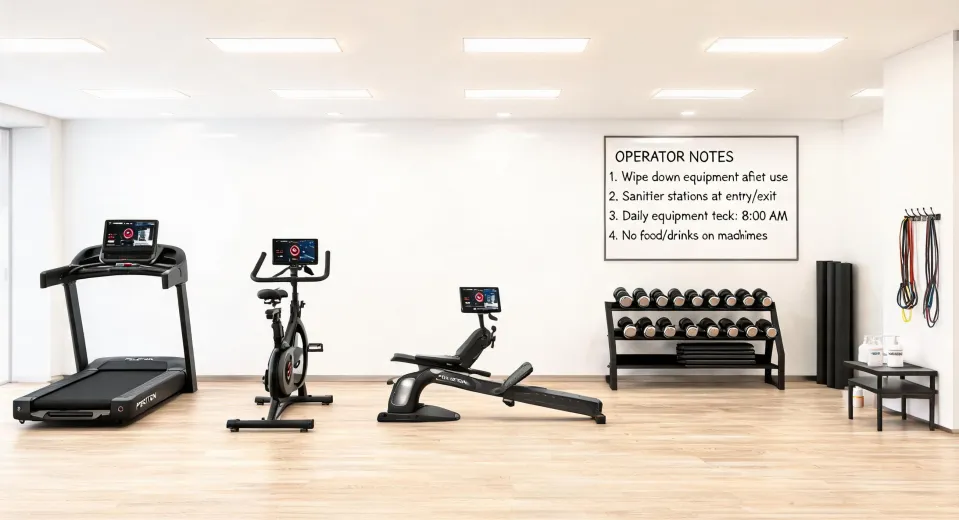
I'm a quality compliance manager at a connected fitness equipment company. I review roughly 200 products a year before they reach customers—treadmills, bikes, rowers, dumbbells, even headphones. In 2024, I rejected 11% of first deliveries. Not because parts were broken. Because marketing claims didn't match actual specs.
When friends find out what I do, I always get the same question: “Why did I stop using my Peloton?”
Not “which bike should I buy?” Not “what's the best treadmill?” The question is about the $2,400 machine that's now a clothes rack.
The usual explanation is “I'm not motivated enough.” I don't buy it. The problem was never motivation. It was verification.
The Surface Problem: Everyone Blames Motivation
The surface problem sounds like this: “I bought a Peloton, used it for three weeks, and now it's gathering dust.”
Then comes the self-blame: “I'm just not disciplined.” Or the brand blame: “The classes are too long.” Or the excuse: “I'll restart next Monday.”
I get why people frame it that way. It's easier to blame willpower than to question the decision process that led to the purchase. But after four years of reviewing fitness products and audit reports, I can tell you that motivation was never the differentiator. The differentiator was whether the buyer verified critical details before spending.
Here's the thing: most people don't have a motivation problem. They have a verification problem.
The Deep Causes: Five Mistakes That Predict Abandonment
I've noticed five patterns that show up again and again when someone stops using a home gym. None of them are obvious at the moment of purchase. That's what makes them dangerous.
1. Compatibility Confusion
The question everyone asks is: “Is this a Peloton compatible treadmill?”
The question they should ask is: “What does ‘compatible’ actually mean in the spec sheet?”
Most buyers focus on whether the treadmill can stream a Peloton class on its screen and completely miss whether it transmits speed, incline, and heart rate back to the Peloton app. Those are two different products. One gives you a class video playing on a treadmill. The other actually participates in the ecosystem: your metrics, your workout history, your progress—all synced automatically.
To be fair, treadmill manufacturers aren't always trying to deceive you. But a spec sheet that says “Peloton app supported” can mean anything from “fully integrated metrics” to “you can prop your phone on the console and play a class at low volume.” If you don't check what “compatible” means in context, you'll likely learn the difference the hard way.
In March 2023, we rejected a batch of 40 treadmills because the stated incline max was 10% on the box and 4% in actual performance. The vendor claimed “industry standard.” We rejected the batch and they redid it at their cost. Now every supplier contract includes explicit performance criteria. I think of that batch every time someone tells me they bought a “compatible” treadmill that left them cheated.
2. The Credential Assumption
Peloton yoga instructors are, for the most part, excellent. They have stage presence, strong followings, and media training. But the question worth asking—the one nobody does—is whether their specific credentials match the type of yoga you need.
I'm not saying the platform skips vetting. I'm saying the platform's vetting might not match your specific needs. Someone with a 500-hour Yoga Alliance certification and a vinyasa background is legitimately excellent—but might not be the right guide for a desk-bound beginner with tight hips. Different teacher, different eye, different adjustments.
The assumption is that a charismatic instructor is automatically a safe instructor. Actually, charisma and safety aren't the same variable. The proof isn't in the follower count; it's in the credentials and continued education.
That's why I tell people to read the bios of the instructors they'll actually train with, not just the brand reputation. It's the same instinct I use when auditing a supplier: the company has a good name, but I still read the specific test results for the specific batch.
3. The Fundamentals Gap
Let's talk about dumbbell goblet squats.
It's honestly surprising how many people—including people who've gone to the gym for years—can't perform a basic goblet squat correctly. Heels lift. Knees collapse inward. The spine rounds because the dumbbell is cradled too low. Instead of the quads and glutes doing the work, the lower back takes the strain.
Now combine that with a premium home gym and a library of advanced classes. What do people do? They skip the fundamentals and jump straight into advanced routines. Form breaks, joints hate it, and six weeks later they're convinced the exercise “didn't work” or “hurt my back.”
People think equipment quality creates results. Actually, fundamental movement quality creates results. Equipment just amplifies whatever you're doing—good or bad. A high-end treadmill won't fix an ugly gait. A $500 pair of dumbbells won't fix an ugly squat. If you can't execute a perfect goblet squat, premium gear isn't a progress hack. It's an injury accelerator.
4. Ears Under Attack
Now, a question I get asked: are bone conduction headphones better for your ears?
The short answer is yes—probably. They rest outside the ear canal, avoid the occlusion effect, and keep your ears ventilated. They're safer for outdoor running because you can hear traffic. I think they're a genuinely good choice for exercise.
But the nuance that often gets lost: they still pass sound through your skull into your inner ear. If you're listening at 90% volume for an hour, the delivery method doesn't matter. The inner ear's hair cells are still taking damage. According to the CDC, prolonged exposure to noise above 85 decibels causes gradual hearing loss (Source: CDC, Noise-Induced Hearing Loss). Bone conduction doesn't change that math.
I'm not 100% sure this is why some people end up disappointed with them, but I suspect they bought bone conduction to solve an ear canal problem when the real issue was volume discipline.
5. The Tyranny of Choice
There's a game called Tyranny—an RPG where the most consequential decisions are made before battle, through alliances and the laws you choose to read. It's a fitting metaphor for home fitness. The decisions that matter most happen long before you step on the machine.
But the way most people shop, those decisions get made under pressure, without criteria. A dozen subscription tiers. Libraries with thousands of classes. Equipment categories that all seem essential at once—cycle, run, row, strength, yoga, meditation. The result is paralysis. Psychologist Barry Schwartz calls it the paradox of choice: more options, less satisfaction. In fitness, it becomes the tyranny of should—“I should use every feature because I paid for it”—and that pressure kills motivation fast.
What Ignoring This Actually Costs
Let's talk numbers, because they're the cleanest.
The Peloton Bike retails at $1,445, and All-Access membership is $44/month (Source: Peloton official site, January 2025; verify current pricing). Two years: roughly $2,501. Add a “compatible” treadmill that doesn't truly sync—$1,400. You're now at $3,900 for a setup that frustrates you every time you walk past it.
That's what we call total cost of ownership. The base price is just the first layer. Shipping, setup, subscription, accessories, repairs, and the opportunity cost of not using it all stack on top. The lowest quoted price is rarely the lowest total cost.
But the financial waste isn't the worst part.
The injury cost is worse. A goblet squat done badly, repeated weekly with heavier dumbbells, is how healthy people end up with avoidable back issues. One U.S. physiotherapy session runs $100–300 (Source: Healthline, 2024). That's three to six months of a fitness subscription, spent fixing a problem that was preventable from the start.
Then there's the trust cost. People who stop using home gyms rarely blame the verification process. They blame themselves: “I'm just not a workout person.” That sentence is the most expensive idea in public health. It stops every future attempt before it starts.
And that self-blame is usually wrong. The WHO recommends 150–300 minutes of moderate aerobic activity per week (Source: WHO Guidelines on Physical Activity, 2020). That's five 30-minute sessions. People routinely overestimate how much exercise is required, then over-invest in equipment to compensate for the imagined complexity.
People think you need strong motivation to start. Actually, motivation follows action. The first workout is the hardest; the tenth becomes automatic. The right question isn't “will I stay motivated?” It's “what system will make me show up?”
That's the logic I apply to quality control every day. We don't ship products on hope. We ship them on verification.
The Fix: A 5-Point Quality Checklist
Look, I don't own a Peloton. I use a stationary bike and free weights. But I've spent four years verifying products for a living, and I can tell you this: the difference between people who use expensive equipment and people who don't comes down to about five minutes of verification before the purchase.
Five minutes of verification beats five days of correction—and in this case, it beats $2,500 of wasted spending.
Here's the checklist I run through with friends who ask what to buy:
- Verify what “compatible” means in writing. If a treadmill claims Peloton compatibility, email the manufacturer: “Does it transmit speed, incline, and heart rate back to the Peloton platform? Or does it only stream class video?” The written answer tells you everything.
- Read instructor bios like a contract. Look for specific certifications—RYT-200 or RYT-500 for yoga, ACE or NASM for strength training. The platform might be trustworthy, but you train with a specific person. Verify that person.
- Master five fundamentals before buying premium gear. Goblet squat, push-up, hip hinge, loaded carry, plank. One month of perfect form with light dumbbells will tell you more than any spec sheet. Then spend the money.
- Apply volume discipline to your ears. Bone conduction headphones are a good choice. Use them at 60% volume max and take breaks. The headphones don't protect you from yourself.
- Name your boring default. What will you do on the day you feel nothing? If you can't name a 20-minute beginner class or a simple dumbbell routine you'll do anyway, you're depending on motivation you won't have in month three.
Prevention isn't glamorous. Nobody gets a dopamine hit from a checklist. But in my line of work, checklists are the cheapest insurance policy that exists.
Your home gym deserves the same standard you'd apply to any other investment. Because the point was never the Peloton. The point is the person—and the decisions they make before they ever hit “start.”