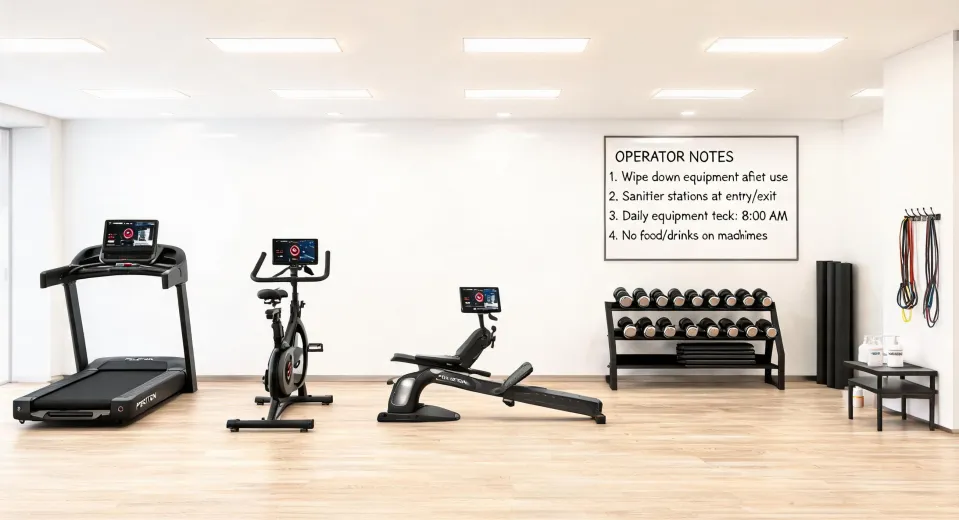
In my line of work—coordinating emergency equipment replacements for hotels, apartment gyms, and corporate fitness rooms—I get the same frantic call at least twice a month. The treadmill is down. A guest is checking in. What can you do?
In March 2024, a 300-key downtown property called me at 2:30 p.m. with exactly that. Their old treadmill had thrown a fault code, and the arriving VIP was a runner who had already mentioned using the gym online. The normal replacement timeline is 10 business days. We found a new Peloton Tread at a regional warehouse, paid $650 for same-day freight, and had it installed before 8 p.m. The guest never knew.
But here’s the thing about that fix: it was easy. The hard problem isn’t moving heavy metal quickly. The hard problem is what happens after the new treadmill arrives.
The surface problem: a fitness center full of good-looking equipment
When I first started doing this, I assumed the problem was obvious: hotels didn’t have good equipment. So they’d buy a new Peloton Treadmill, slap a “premium fitness center” sign on the door, and wait for the five-star reviews. And it worked—for about two weeks.
Then the screen automatically logged out. The Wi-Fi network didn’t cover the gym. Nobody could pair headphones with the console. A guest clicked “Pilates” and saw a video that required a Peloton Pilates ball. There wasn’t one. The queue to use the treadmill was 25 minutes, because the hotel only had one machine. And the kettlebells someone ordered were still sitting in receiving because there was no rack.
That’s the moment I realized the equipment isn’t the product. It’s just the packaging.
The deeper problem: you’re buying hardware, but members are buying a system
Peloton’s model is often described as “hardware plus content,” but I think that undersells it. From the outside, a Peloton Tread is a treadmill. From the member’s point of view, it’s a door into a very specific experience: instructor-led classes, live scheduling, performance tracking, even a kind of social accountability. If any one of those pieces breaks—if the screen is dark, if the account is frozen, if the connection drops—the whole experience collapses.
The mistake I see in B2B installations is treating the treadmill like an elliptical with a screen. You bolt it to the floor, plug it in, and assume the software will take care of itself.
It won’t. And that’s not a Peloton problem; it’s a service-design problem.
Here’s an example from last quarter. Two hotels about the same size both added connected fitness equipment. One bought a new Peloton Treadmill (priced at $2,995 on peloton.com as of May 2024, before delivery and setup) and called it a day. The other created a small “connected studio” area with the Tread, a Bike, and a few accessories—Pilates ball, kettlebells, mats, and extra headphones. I’m not saying the first hotel failed. I’m saying the second one had noticeably more class participation in the first month, not because the equipment was better, but because the system made it easier to start.
Guests don’t search “what is headphone” at 5:50 a.m. because they want a definition. They want to know whether they’ll be able to hear the instructor. If you don’t have a pair that pairs fast with the console, the guest won’t take the class. They’ll do five minutes on the treadmill and leave. A $2,995 connected treadmill that nobody can hear is worth less than a $300 used air bike that gets used.
What the real problem costs
I’m not a revenue manager, so I can’t put a precise dollar figure on a lost guest. But I’ve been in enough fitness facilities to know what a neglected room looks like: a disconnected screen with a “software update” message, a sticky floor, cables tangled underneath the machine like something out of Twisted Metal (1995 video game)—except there’s nothing fun about it.
And guests notice. Not always consciously, but they notice.
In the 2024 ACSM Worldwide Fitness Trends report, wearable technology and mobile fitness apps remain near the top of the list. That tells me people expect digital fitness options. It also tells me that expectations are higher than before: a gym with one isolated treadmill isn’t automatically obsolete. It’s just not enough, if the equipment can’t deliver a complete experience.
The cost shows up in reviews, in churn, and in conversations you don’t hear. I’ve had fitness directors tell me their CFO questioned the ROI of a new Peloton order because “the gym is always empty.” But the gym isn’t empty because the equipment is unpopular. It’s empty because starting a workout is too many steps.
The short answer: treat it like an operating system, not furniture
I don’t want to make this article longer than it needs to be. You have deadlines, too.
If you’re planning to add Peloton equipment—a new Peloton Treadmill, a Bike, even a rower—my advice is to plan the operating environment before you place the order. That means:
- Assign a staff owner for the fitness room, even part-time, whose job includes checking software updates, app logins, and headphone charging every morning.
- Stock what the classes actually require. If you offer Peloton Pilates classes, get the Peloton Pilates ball. If you have strength classes with a kettlebell swing sequence, buy kettlebells in at least two weights. Don’t leave a guest staring at a video they can’t follow.
- Make audio easy. Keep a few wireless headphones next to the console, with a sign that says “Ask at front desk.” It removes the main barrier between a guest and a class.
- Build in a buffer. Our company now requires a 48-hour pre-install site check for every project. It saves us from elevator-size mistakes and surprise electrical issues.
In my first year in this industry, I made the classic rookie mistake: I assumed the most expensive part of a project was the machine. It isn’t. It’s the 18 months after installation, when the hardware is alive on the inside and no one is taking care of it.
Traditional dumbbells and benches aren’t obsolete—they still do their job. But connected equipment has a job too, and it’s not happening automatically. This approach won’t work for every property. If you’re running a 500-key convention hotel with a 24-hour gym and a full-time fitness staff, your checklist will be different. For most B2B fitness spaces, though, the principle holds: connected fitness is efficient fitness—but only if you design for the connection, not just the equipment.
The good news? Once you get the system right, the hardware is the least interesting part. And that’s how it should be.