There's No "Best" Olhausen. There's Only What Fits Your Venue.
Every time someone asks which Olhausen pool table is "best," I give the same answer: the one that matches your venue, your guest behavior, and your delivery deadline. That's it. There is no universal recommendation.
I'm a quality and brand compliance manager for a commercial entertainment equipment distributor. I review every unit before it ships to customers—roughly 200+ items annually, including pool tables, ping pong table tops, air hockey tables, foosball, and accessories. In Q1 2024 alone, I rejected 12% of first deliveries due to spec drift, shipping damage, or installation mismatches.
Here's what that experience taught me: the choice depends on your scenario. Not your budget alone. Not the model your competitor bought. Your scenario.
There are three types I see most often.
Scenario A: The High-Traffic Bar or Tavern
If your pool table lives where customers drink, lean, bump, and occasionally spill, prioritize durability and slate stability over decorative cabinet work.
From the outside, Olhausen's catalog looks like a style decision—Sheraton, Belmont, Eclipse, Waterfall. The reality is these models differ significantly in frame construction, slate thickness, and rail durability. Style is what customers notice. Structure is what keeps the table level after 18 months of Friday-night abuse.
For this scenario, I'd point to the Olhausen Waterfall line. The Waterfall's frame design handles the kind of play where the felt sees more elbows than clean shots. Its slate bed is thicker, which translates to fewer re-leveling calls and longer felt life. When you search for an olhausen waterfall pool table for sale, check who's offering commercial-grade installation—not just the lowest sticker price.
On the olhausen pool table weight: according to published product specifications, an 8-foot Olhausen table typically lands somewhere between 800 and 900 pounds depending on slate configuration and cabinet style. That's 20–30% heavier than many economy imports. Weight is stability—a heavier table doesn't walk when a guest stumbles into it. But it also means you need to verify floor load capacity and plan the delivery route. We had one installation where the table didn't fit through the back door. The venue had to remove a doorframe. That added $600 and a day of downtime to a project nobody had budgeted for.
One counterintuitive part of this scenario: showcase your cues. Pool cues aren't just accessories—they're revenue items. Offer them as a paid rental or upsell. We observed one venue increase table-side spend by 22% simply by mounting a visible cue rack next to the table instead of storing cues behind the bar.
Scenario B: The Family Entertainment Center (FEC)
Family entertainment centers have a different problem: turnover. Not the employee kind—the equipment kind. Your tables run 8–14 hours a day, seven days a week.
The assumption is that more expensive tables automatically last longer. Actually, tables that last longer are the ones designed with replaceable components, and that's why they cost more. The causation runs the other way. When you're specifying for an FEC, ask three questions before anything else: Can the felt be replaced without moving the slate? Are the rails independently serviceable? Does the manufacturer rate the table for continuous commercial use?
We specify Olhausen ping pong table tops for our FEC clients because of the rail design—it holds up to players who don't know how to hold a ping pong paddle properly. That matters more than you'd think. A bad grip leads to paddle-edge strikes against the table surface, which chips the playing layer faster than normal play. We printed a small instructional card—three steps, one diagram—and mounted it next to each table. Replacement costs dropped from roughly $200 annually per table to under $40. A piece of paper saved $160 a year per unit.
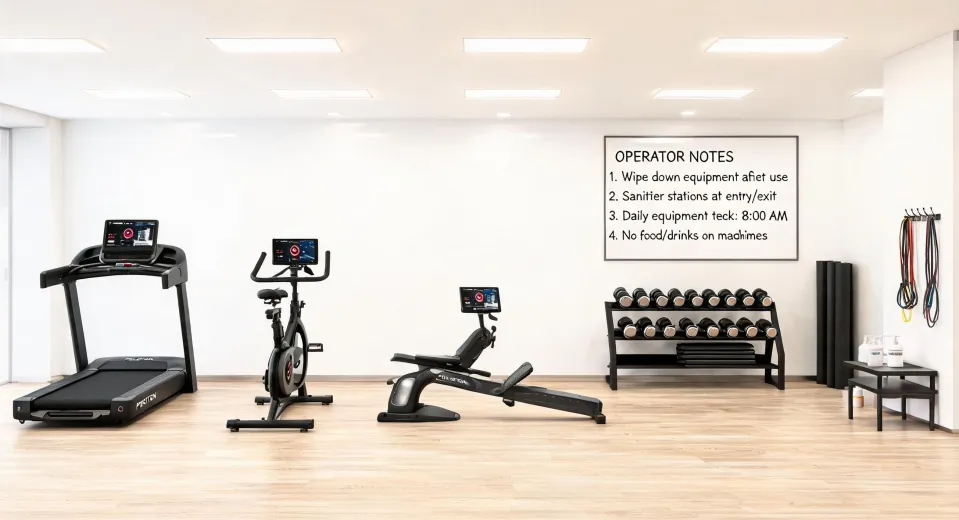
FECs also mix equipment. Many of the centers we supply pair game areas with fitness zones—we've seen kettlebell weights and seated leg press for glutes machines placed right next to foosball and air hockey setups. The cross-traffic works: parents work out while kids play, then everyone swaps. It keeps families on-site longer and increases average spend per visit. If you're building out a mixed-use floor, don't silo your game equipment from your fitness equipment. Traffic flows between them.
For FEC pool tables specifically: buy the model with the thickest slate you can afford, and budget for a spare felt set at the time of purchase. You will need it. Not if. When.
Scenario C: The Hotel or Corporate Venue
Hotels, corporate lobbies, and event spaces have a different priority: appearance and delivery certainty. Durability matters, but no one's dragging a stool across the table at 11 PM.
For a boutique hotel or a tech company's break room, the cabinet style carries more weight than the slate specs. Olhausen's Sheraton and Belmont cabinets exist for exactly this environment—decor-compatible furniture that happens to be a playable pool table. These are showpieces. Buy them for how they look when the room is empty, not just how they play when it's full.
Now the part that makes some procurement teams wince: rush delivery economics.
In March 2024, we paid $400 extra for rush freight on a hotel installation. The alternative was missing a $15,000 opening event because the original shipment was delayed two weeks. We approved the rush fee and I immediately second-guessed it—could I have negotiated a better rate if I'd caught the timeline issue earlier? The five days until the truck arrived were stressful. It showed up a day early, everything intact. I relaxed then.
Here's my position, and it's not universally popular: in time-sensitive situations, pay for delivery certainty, not just speed. "Probably on time" is the biggest risk you can take. The $400 rush fee protected a $15,000 event. That's not a cost—it's a hedge. After getting burned twice by vendors who promised delivery "around the 15th," we now bake guaranteed scheduling into every contract that has a hard opening date.
What I won't tell you: that rush fees are always worth it. If your timeline has slack, save the money. If it doesn't, don't gamble.
How to Determine Which Scenario You're In
Ask three questions in this order:
1. Do your guests physically contact the table in unpredictable ways? If yes—bars, taverns, clubs—go with Scenario A. Prioritize frame integrity and slate weight.
2. Does the table run more than 8 hours a day? If yes—FECs, arcades, recreation centers—go with Scenario B. Prioritize serviceability and replacement cycle planning.
3. Is the table a design element in a visible space? If yes—hotels, corporate offices, showrooms—go with Scenario C. Prioritize cabinet style and delivery scheduling. And if you have a hard opening date, budget the rush premium without guilt.
Most venues are hybrids. A bar might have a VIP area that calls for Scenario C styling. An FEC might have a private party room that needs Scenario A ruggedness. Pick your primary scenario first, then layer the secondary requirements on top.
One last note on compliance: per FTC advertising guidelines (ftc.gov), claims like "commercial grade" or "tournament quality" must be substantiated. When you're reviewing an Olhausen listing—or any brand's—ask for the actual spec sheet. If the seller can't produce it, that tells you something about the product and the seller. Both matter.
The right table isn't the most expensive one or the one your competitor owns. It's the one whose failure points match the risks you can actually manage. Figure out your scenario first. The model number follows.