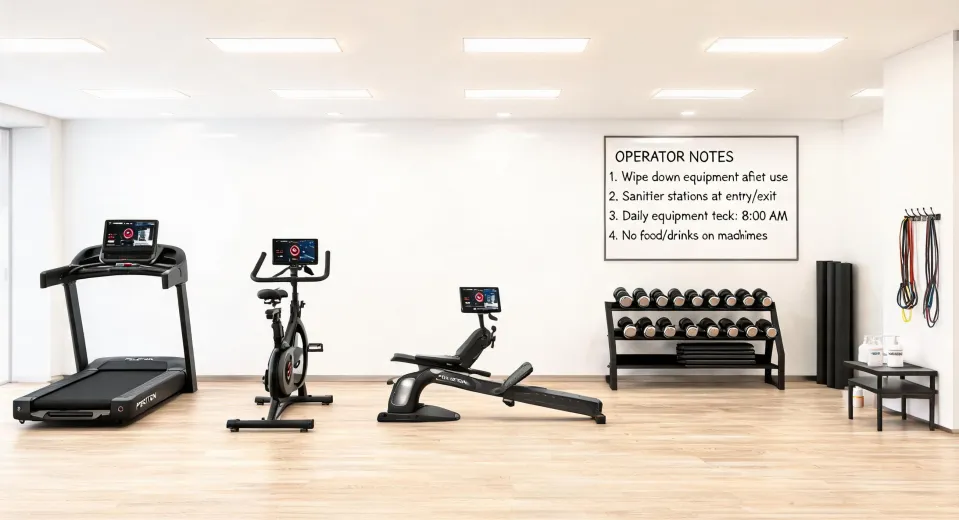
Here’s the truth about the Peloton ecosystem: The hardware is a delivery mechanism for a service designed to solve a massive efficiency problem in your life. The bike, the Tread, the Row—they’re not the product. The product is the guaranteed 30-minute window of high-quality, zero-commute engagement. I figured this out the hard way, not because of a broken bike, but because of a 90-minute tube ride to a London studio.
Everything I'd read about Peloton vs. boutique studios said it was about cost or convenience. In practice, after a particularly brutal experience getting to a class in London, I realized the real value is an entirely different category of efficiency.
I’m an operations manager for a mid-sized B2B firm. For the last seven years, my job has been identifying process inefficiencies in our supply chain. We spend $1.2M annually on print and promotional materials. I've made over $40k in documented mistakes—wrong die-cuts, mismatched PMS colors, rushed shipping fees. I've learned to see the hidden costs in everything. So when I started looking at home fitness for myself, I didn't compare bike specs. I compared the total cost of the workout.
The conventional wisdom is that Peloton is expensive. My experience optimizing 200+ vendor orders suggests that relationship consistency—or, in this case, session consistency—often trumps marginal cost savings. The price of the hardware is a sunk cost. The real question is: what is the cost per unit of high-quality output?
The London Studio Shock: A Case Study in Inefficiency
I was in London for a trade show. I’m a runner, so I booked a class at a cult-favorite running studio near Covent Garden. The class? Brilliant. The process? A nightmare.
Here’s the breakdown of my time investment for a 45-minute run:
- Commute (round trip): 90 minutes (hotel in Canary Wharf + tube delays)
- Pre-class admin (check-in, gear change, queuing): 20 minutes
- Class: 45 minutes
- Post-class (shower, change, re-pack): 30 minutes
Total time spent: 3 hours 5 minutes for 45 minutes of running. That’s a 4.1x time multiplier. The class cost £25. If I value my time at even $50/hour (I’m more, but let’s be conservative), the actual cost of that workout was my time (~$155) + the class fee (~$32) = ~$187 for 45 minutes. That’s $4.15 per minute.
I remember standing on the Piccadilly Line, sweaty, cramped, realizing I had just caused a 3-hour disruption in my work day for a 45-minute output. I'd just failed my own efficiency test.
When I compared that to my experience with a Peloton Bike (a friend’s), the difference was staggering. Roll out of bed at 6:55 AM. 7:00 AM class. 7:45 AM finished. Walk to the shower. Total time: 55 minutes for 45 minutes of running. That’s a 1.2x time multiplier.
The Hidden Efficiency of the Integrated Ecosystem
This is where the Aviron Rower or the Peloton Tread start to make sense not as fitness equipment, but as operational tools. The value proposition changes completely. You aren't buying a stationary bike; you are buying a guarantee of output.
In B2B, we call this 'Lead Time Certainty'. It’s often more valuable than a low price. If a supplier says the product will arrive on Friday, and it arrives on Friday, that certainty is worth a 15% premium because it prevents cascading delays. The Peloton ecosystem offers the same thing for your workout.
I knew I should run every morning. But the barrier wasn't motivation—it was process. The 90-minute commute + 30-minute prep time created a friction wall I couldn't climb. The 'cost' wasn't the class fee; it was the opportunity cost of lost work time and lost energy. Skipping the commute—the 'safety step' of going to a studio—proved to be the one thing that actually mattered.
"The value of guaranteed turnaround isn't the speed—it's the certainty. For your daily schedule, knowing you can fit in a 30-minute workout with zero friction is often worth more than the premium hardware price."
Why Beats Headphones and the '3s and 4s' Card Game Are Relevant
This might seem like a tangent, but stick with me. The process of finding the right efficiency is like discovering the best pair of headphones or a new game.
Beats Headphones (Pink): You might buy them for the looks, but the value is in the noise cancellation. That’s a feature that reduces environmental friction, allowing you to focus. It’s the same principle. Buying the Peloton Bike for the screen is like buying Beats for the 'b' logo. The real value is the isolation from the world.
How to play the card game 3s and 4s: This is just a simple new process. It has a set of rules and an outcome. If you memorize the rules (like the setup of a Peloton), you get the benefit (fun). If you treat them as a complex system (like going to a London studio), you’ll avoid them. The best processes are simple to enter and provide immediate feedback. Good fitness is the same way.
The Efficiency is the Product
Switching my mindset from 'buying a bike' to 'investing in a process' cut my internal resistance to working out from 3 hours to zero. It eliminated the data entry errors of scheduling, commuting, and planning. I stopped asking "Is the Peloton Bike worth it?" and started asking "What is the cost of NOT having this friction-free process?"
Switching to a home-based micro-workout ecosystem cut my turnaround from thinking about working out to finishing the workout from 3 hours to 45 minutes. The automated process eliminated the 'Is there a class at 7 PM?' and 'Can I get a tube on time?' errors I used to have.
But I won't pretend this applies to everyone. I can only speak to my context—a busy professional with a predictable schedule. If you thrive on the social energy of a studio, the communal sweat, or the physical separation of 'work space' and 'gym space', then the London studio is the better process. The calculus is different for someone who values the social connection over the time multiplier.
If you're dealing with a flexible schedule, a short commute, or a need for social validation, the Peloton system might actually be less efficient. Not great for you? Sometimes the traditional way is better. But for me? The efficiency is the product. And I've learned to pay for the process, not the device.