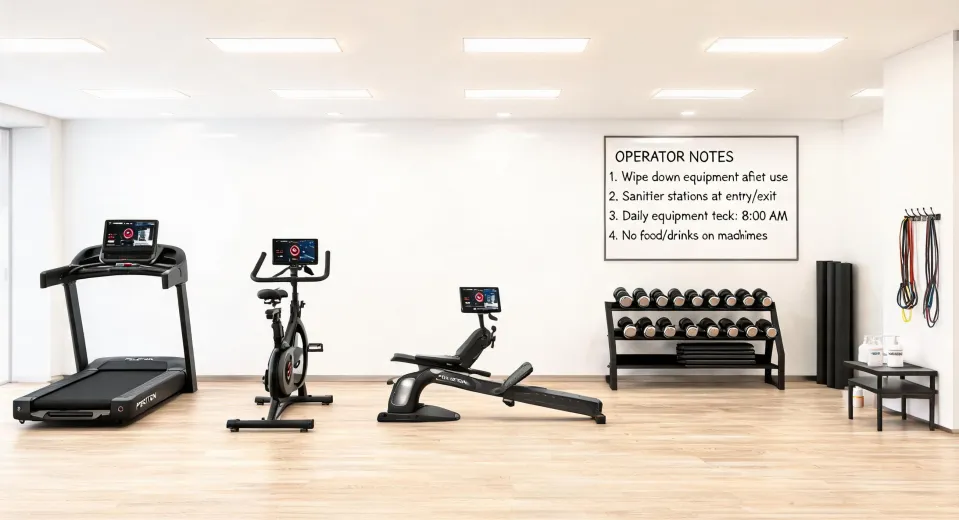
I manage procurement for a 300-person company, and I report to both operations and finance. That means I've signed POs for everything from office chairs to the coffee machine. And if you ask me, buying fitness equipment for a corporate gym is where most organizations make a costly mistake: they choose the cheapest option and then wonder why nobody uses it.
My position is simple: in procurement, total value beats unit price every time. That's not a slogan. It's the difference between buying a tool that gets used and a monument to a bad decision.
Why I Don't Start With the Price
When someone asks me about a Peloton treadmill discount, my first response isn't "how much?" It's "how many people will actually use it?" Because the cheapest equipment in the world is too expensive if it sits unused.
Here's the thing: a fitness room isn't about having equipment. It's about helping employees change their behavior. And behavior change requires engagement. A $2,000 bike that gets ridden 50 times is a better deal than a $500 bike that gets ridden twice. That sounds obvious, but I've had finance leaders push back on me because the cheaper option "looked more responsible."
Let me be direct: three things matter—usage, reliability, adoption. In that order. The lowest quote has cost us more in roughly 60% of cases. That's from my own history managing vendor purchases since 2020. It happens because of hidden costs: repairs, downtime, low adoption, and the eventual cost of replacing the thing with the equipment you should have bought in the first place. (Should mention: I learned this the hard way with a "bargain" treadmill that broke down 7 months in.)
Total Cost Is More Than the Purchase Order
Total cost of ownership includes the base price, shipping, setup, maintenance, and the opportunity cost of a room that no one uses. What I mean is that the "cheap" option starts with a low invoice amount but often generates costs that never appear on that invoice: time spent troubleshooting, employee disappointment, and the emotional cost of a wellness program that feels like a joke.
Take the treadmill walking pad category. A treadmill walking pad is reasonably priced, and for some employees it's a legitimate way to get more steps during the day. But if your goal is to create a meaningful fitness program, a walking pad is not a replacement for a dedicated cardio machine with structured programming. It's a supplement. Buy it if you need it. Just don't buy it because it's the smallest line item on the budget.
In our 2024 vendor consolidation project, I compared the upfront cost of outfitting our gym with Peloton equipment versus less expensive options. The conventional equipment was 20% cheaper on paper. But after accounting for expected maintenance, replacement cycles, and employee participation rates, the total cost per workout was actually lower with Peloton. I don't have the exact figures in front of me—don't hold me to the math—but that's the analysis that convinced our finance team.
Engagement Is the Metric That Matters
The reason I focus on engagement is simple: a stationary bike is only good for weight loss if people are willing to get on it. It's tempting to think a bike is just a bike. But that oversimplification ignores the biggest factor: consistency. So when someone asks "is stationary bike good for weight loss?", my answer is yes, but not because the bike burns calories. It's because a connected bike with a class library creates a reason to come back.
Take an example Peloton workout: a 20-minute HIIT ride with an instructor who tells you exactly when to push and when to recover. That's not magic. It's structure. For an employee with no athletic background, that removes the "I don't know what to do" barrier. The bike becomes a coach, not just a machine.
That's where the Peloton ecosystem matters. It's not just the hardware. It's the class schedule, the metrics, the community. And if you're setting up a shared fitness room, the peripheral details matter too. We added a few pairs of Bose QuietComfort SC noise cancelling headphones after noticing that employees were avoiding the rower because they couldn't hear the instructor over the ventilation system. That was a small investment, but it removed a real obstacle.
I should add that this isn't about rejecting cheaper alternatives. I'm not saying every treadmill walking pad is useless or that budget brands are always bad. At least, that's been my experience with our particular workforce. But here's the principle: encourage the behavior, then fund the equipment. Most procurement failures happen because we fund equipment before asking whether anyone will use it.
The "Discount" Trap
A Peloton treadmill discount can be a good deal. But if the discount is the main reason you're buying, you're making the same mistake as the person who buys a $300 elliptical because it's on sale. The discount doesn't matter if the equipment doesn't get used.
As of May 2024, Peloton's B2B pricing is quoted case by case, and the discount depends on volume and contract length. If you're negotiating, ask for a breakdown that includes hardware, content licenses, and delivery. That's the only way to compare total cost. Verify current pricing through your Peloton B2B sales contact, because rates may have changed.
So when a vendor asks me "do you want to see our discount pricing?", I ask a different question: "What's the onboarding and employee adoption plan?" If the answer is "you'll get great content with the hardware", that's usually enough. But if I'm expected to promote it internally, that's a cost too.
My experience: a vendor who can't explain how their equipment will be used is a liability. I say this after 4 years of managing these relationships—and after one expensive lesson with a supplier who sold me on price but didn't deliver on setup. That single part of the project cost us two weeks of gym downtime and a $1,800 charge for a local technician. The "cheaper" quote ended up costing more than the premium one would have.
But What About Budget? (The Question Everyone Asks)
I get it. Budgets aren't infinite. If I'm honest, there are times when you have to start smaller. That's fine—as long as you're honest about the trade-off. A smaller Peloton setup (maybe 2 bikes and a strength bundle) is a better starting point than a full room of generic equipment that nobody asked for.
Also, let's consider the price hidden in plain sight: an unused gym isn't saving money. It's wasting the square footage, the electricity, the cleaning hours, and the benefits budget. Put another way: a wellness program that fails has a real cost. It erodes trust. Employees stop believing the company is serious about health.
If you're a small company with a tight budget, the right move is not always a Peloton purchase. You could start with a simple walking-pad-and-headphones pack. But buy what you can maintain and what your team will actually use. At least, that's been my experience with our workplace. Take it with a grain of salt.
Buy for the Workout, Not the Sticker
After 4 years of managing procurement, I've come to believe that the best purchase is the one that creates a habit. That means the question isn't "which machine is the best?" It's "which machine will this person use consistently?" For many employees, that answer is a connected fitness platform like Peloton—not because it's flashy, but because the structure of classes and community makes the exercise decision easier.
The same logic applies to supportive items. The Bose QuietComfort SC noise cancelling headphones aren't the cheapest option. But if they help an employee focus on a workout without distractions, they're not an expense. They're part of the total operating system that makes the equipment effective.
So, is stationary bike good for weight loss? Yes—when it's part of a routine someone actually follows. A treadmill walking pad? Great—if it's integrated into daily movement rather than sitting in a corner. A Peloton treadmill discount? Take it, if you've verified the total value. But don't let a lower sticker price be the hero of the story.
The best fitness purchase is not the cheapest one. It's the one that gets used.