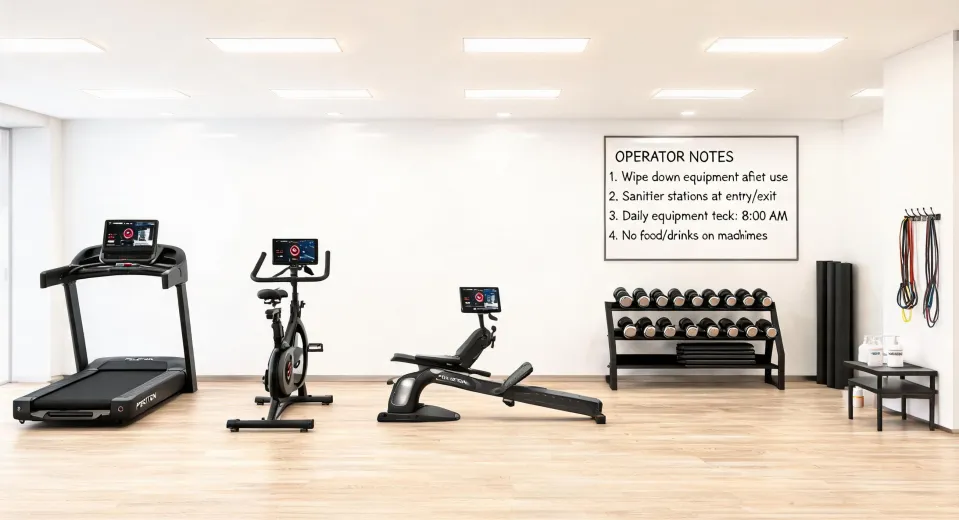
I don’t have a single yes-or-no answer for “should we buy Peloton equipment for a shared gym?” If someone gives you one before seeing your usage data, that’s not advice. That’s a sales pitch.
I’m the procurement manager for a 140-room hospitality group. I’ve managed our fitness amenity budget—around $85,000 a year—since 2019. In that time I’ve compared more than twenty vendor quotes, audited too many surprise invoices, and watched expensive equipment become a clothes rack. I’m not anti-Peloton. I’m anti-waste. The way to avoid waste is to figure out which piece of the Peloton ecosystem, if any, solves a problem your people actually have.
Peloton isn’t one purchase
When I started in this role, “Peloton” meant an expensive bike with a screen. Today the company sells bikes, treadmills, rowers, strength accessories, and class libraries like Peloton Yoga and Peloton strength. Peloton dumbbells are also a separate line item, not an afterthought.
That matters because a vendor proposal that says “Peloton solution” without separating hardware, subscription, installation, and accessories is not a proposal. It’s a threat to your budget.
I once said “we need more fitness programming.” My colleague heard “we need another connected bike.” Result: a purchase order with hardware but no budget to promote the classes. We were using the same words and meaning different things. Now I write the deliverable in one sentence before I ask for quotes.
Three scenarios that change the answer
Rather than comparing spec sheets, I divide every project into three scenarios. It isn’t as fun as a product review, but it makes the budget decision easier.
1. The amenity space that has to attract people
This is the hotel gym, apartment fitness room, or premium office lobby. If people choose your building partly because of the gym, the equipment needs to make a strong first impression. In this scenario, one or two connected bikes with a clear screen can be the anchor that makes the room feel intentional.
But even in an amenity space, I resist the full-catalog approach. I looked at Peloton dumbbells for a renovation because the vertical rack looked sharp in the space render. The quote was roughly double what we would pay a commercial equipment vendor for the same weight range. On a hotel floor, guests don’t care whether the dumbbell has a logo. They care whether the 15-pound pair is in the right spot. We saved that money and used it for benches and better mats.
If you run an ultra-luxury property where brand consistency is part of the interior design, branded dumbbells can still make sense. That’s a design expense, not a fitness expense.
The accessory that did earn its place was the Bose Noise Cancelling Headphones 700. Our studio shares a wall with a meeting room. The estimate to soundproof it was $4,800. Two pairs of Bose 700s cost far less and are checked out at the desk for use with the bikes and the yoga screen. They pair quickly, the battery lasts, and the noise complaints stopped.
2. The office gym where participation is the ROI
If this is an employee perk, the decision changes. Employees don’t care about the marketing photos. They care whether they can finish a workout in thirty minutes without feeling awkward or rushed.
When I set up an employee workout room in one of our buildings, I ran a simple survey. Peloton Yoga was near the top of the list. A twenty-minute strength class with moves like the shoulder dumbbell press was second. Cycling finished further down. That told me the room needed a large screen, a wall mount, and a subscription—not a second cardio machine.
A shoulder dumbbell press doesn’t need a connected dumbbell. It needs a bench, a manageable pair of weights, and someone on a screen who knows how to teach bracing and tempo. If you already have the weights, the missing piece is programming. Buy the programming.
3. The strength and yoga room that already has cardio
This is the counterintuitive one. If you already have treadmills and a stair climber, buying another connected cardio screen is usually the wrong answer. Yet it’s the move most vendors will suggest.
The most used room in our building is not the cardio corner. It’s the strength and stretch studio with dumbbells from 5 to 50 pounds, two benches, mats, and a big TV. When we added Peloton Yoga and Peloton strength classes on that TV, usage jumped. We didn’t need another bike. We needed a coach and a structured class library.
Would Peloton dumbbells have made that room better? They look cleaner and the storage rack saves floor space. But for a shared space where people are doing basic movements like a shoulder dumbbell press, the value is in the class instruction, not in the branding on the iron.
The cost method I use for all three scenarios
Here is the three-year calculation I run before any purchase: add hardware, delivery, installation, accessories, subscription, service, and estimated replacement cost. Then divide that by expected weekly sessions times 50 weeks times three years.
A connected cardio machine in our guest gym had a first-year cost around $3,100 once installation, accessories, and staff setup time were included. Years two and three added roughly $700 each for subscription and service. At six uses per week, the three-year cost per workout was about $5.60. At two uses per week, it jumped to almost $17 per workout. Same machine. Same quality. Completely different decision.
That’s why I now ask every vendor one question: “What is not included in this price?” The lowest quote in a recent project excluded delivery and unpacking. That added $450 to the final bill—more than the inclusive quote from another vendor. Since then, our request-for-quote template has a line for “Everything included.” If the vendor leaves it blank, we don’t move forward.
How to tell which scenario you’re in
The fastest way is to watch the room for two weeks. Not during a grand opening. After the novelty wears off. Count what gets touched.
If the treadmill is busy but the bike sits idle, don’t add another bike. If people ask for yoga classes and strength programming, don’t spend the same money on another screen attached to a cardio machine. If the fitness room is part of your sales story, invest enough to make it look like a destination—but do it in proportion to the traffic you can realistically support.
An informed customer asks better questions and makes faster decisions. I’d rather spend ten minutes explaining options than deal with mismatched expectations after the invoice. Buy for the room you have, the people who actually show up, and the usage you can measure. That’s the whole game.