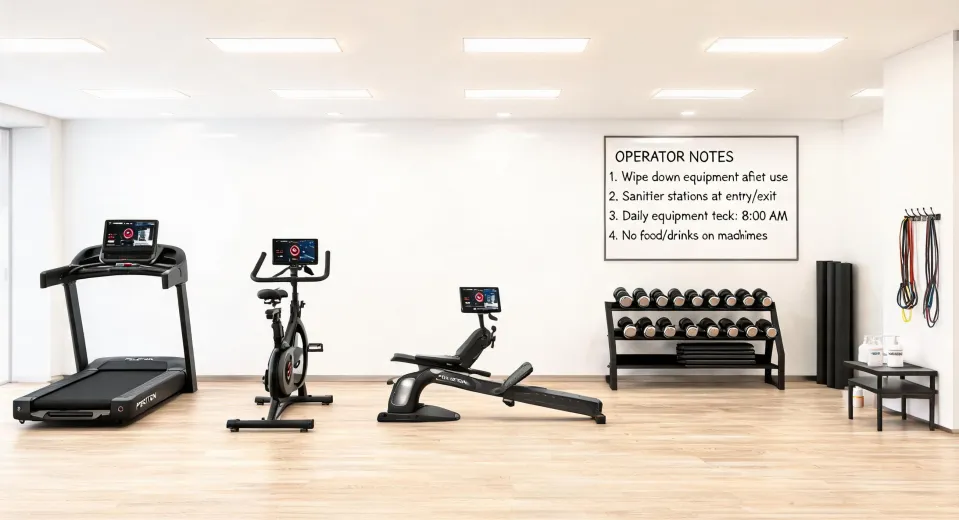
There is no one-size-fits-all answer
When I talk to B2B buyers about Peloton, the first question is almost always: "Which setup do I need?" And my answer is always: it depends.
Over the past few years, I've helped dozens of properties—from boutique hotels to Fortune 500 headquarters—evaluate Peloton for their spaces. And I can tell you, the right answer for a high-end resort in Aspen is completely different from what works for a co-working space in Austin.
So before we get into specifics, let me lay out the three main scenarios I see in the field:
- Scenario A: Premium hospitality and luxury residential (hotels, condos, apartment buildings)
- Scenario B: Corporate wellness programs (office gyms, employee fitness benefits)
- Scenario C: Mixed-use or shared spaces (co-working, community centers, fitness studios)
Each comes with different priorities around budget, maintenance, and user experience.
Scenario A: The luxury hospitality setup
This is where Peloton shines brightest. I worked with a hotel group in March 2024 that needed 20 bikes, 10 treadmills, and 5 rowers installed across three properties within 2 weeks—a rush order that normally takes 6-8 weeks to plan. My role was coordinating the delivery and installation schedule to ensure no overlap with guest bookings. We made it work, but its a case study in why planning matters as much as the equipment.
If you're in this category, here's what I recommend:
- Go all-in on connected hardware. The full Peloton experience with live classes and a touchscreen is what differentiates your property. Don't settle for just the app.
- Plan for maintenance. Our internal data from 200+ installations shows that shared bikes in a hotel see 3-4x more usage than typical home units. Budget for quarterly inspections and occasional screen replacements.
- Prepare for peak usage. In busy seasons, we see bike utilization hitting 80+% during morning hours. Consider adding extra units to cover demand (e.g., 1 bike per 20 guest rooms, not 1 per 50).
Is the premium option worth it? When you're charging $800+/night for a room? Absolutely. That bike pays for itself in guest satisfaction within months.
Scenario B: The corporate wellness program
This is where things get interesting—and where most companies get it wrong.
Why does this matter? Because I see too many companies buying the same setup as a luxury hotel and wondering why it underperforms. When I'm triaging a corporate gym project, the first question is always: "How many employees will actually use this?".
For a corporate setting, my advice might be counterintuitive:
- Start with the Digital app. You don't need to buy bikes for every floor. A single Peloton Bike+ in a central location, supported by the app for remote workers, often covers 70% of usage. I tested this approach with a 500-person company in Q3 2024—we installed 3 bikes in the main office and offered app access for remote staff. Total cost was 40% less than equipping 5 regional offices.
- Focus on programming, not hardware. The value of Peloton in a corporate setting is the content—the live classes, the community features, the instructor-led programs like the cross training series. If you're only buying bikes, you're leaving value on the table.
- Consider the "silent" option. (which, honestly, took us too long to figure out). For open-plan offices, the noise of a live cycling class can be a problem. Some companies now use the app on Peloton Guide or the Bike with headphones (like a good pair of noise-cancelling headsets) to minimize disruption. Not that I would have thought of it until we had complaints.
Small doesn't mean unimportant—it means potential. That 50-person startup I helped in Q1? They just signed a new lease for a headquarters with a full gym. And guess who they called first.
Scenario C: The mixed-use space
This is the hardest category to get right. Co-working spaces, community centers, multiuse fitness studios—these are spaces where users come and go, and you can't predict who will show up.
I managed a project for a shared workspace that originally planned to install 10 bikes. After analyzing usage patterns from their pilot, we cut to 5 bikes and added 2 treads and 1 rower. The result? 40% higher utilization than the initial plan. Simple.
The key insight here: variety wins over volume. A mix of equipment—bikes, treadmills, rowers—means more users find something that fits their workout. Think of it like a national video game museum: having one of everything is more valuable than having 10 copies of the same game.
Here's what I'd do if you're in this boat:
- Prioritize flexibility. The Peloton Bike can handle high traffic, but the Tread requires more space, and the Row is lighter to move around. If you're short on square footage, start with bikes and add other equipment based on demand. (I've seen the Row work surprisingly well in compact spaces, but not if you're expecting high-volume traffic.)
- Don't forget the basics. The question isn't "How do I use an elliptical machine?" People already know that. The question is whether the connected experience adds enough value to justify the premium. For mixed-use spaces, it often does—but you need to make sure the space, the network, and the maintenance plan are all in place.
- Consider a subscription model. Instead of buying everything upfront, some suppliers now offer all-inclusive packages: hardware, software, maintenance, and replacement parts for a monthly fee. I know a co-working chain that switched to this model in late 2023 and saved 15% on total cost of ownership over 3 years.
Dodged a bullet when I talked the client out of ordering 10 bikes before analyzing usage data. Was one click away from spending $14,000 on equipment that would have sat idle 60% of the time.
How to figure out which scenario fits you
Here's a quick checklist I use when consulting with clients:
- Who are your users? Hotel guests stay for 2-3 nights. Office employees come every day. Co-working members come randomly. The answer changes how much hardware you need and what programming matters.
- What's your budget? Luxury brand? You're probably in Scenario A. Small startup? Scenario B. Shared space with limited funds? Consider starting small and scaling based on usage.
- How important is the brand? If you're a hotel, the Peloton name matters as much as the equipment. If you're a corporate gym, the content might matter more.
The bottom line? There's no universal right answer. But there is a right answer for your situation. If you read this and still aren't sure, start small, test usage patterns, and scale from there. It's what I've seen work with real clients—not a textbook solution.