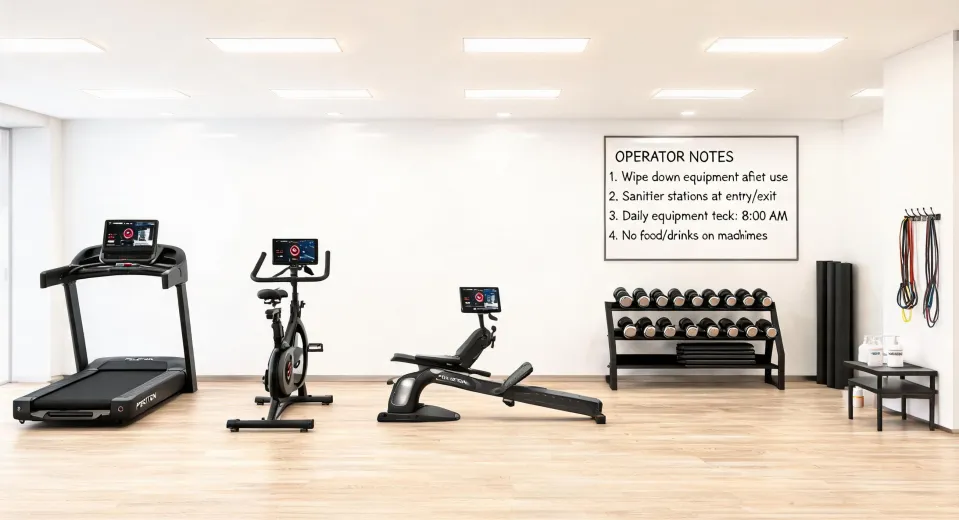
I review fitness equipment before it goes to customers. That's my job—spec sheets, marketing claims, assembly instructions, the stuff people don't read until something breaks. Since 2021, I've reviewed about 200 product pages a year. In 2024, I rejected 12% of first submissions because the messaging didn't match the hardware.
So when someone asks, 'Does the Peloton Treadmill fold up?' the answer is short. No. It doesn't. Neither the Peloton Tread nor the Tread+ has a folding hinge. You're not missing a hidden mechanism—it's a fixed-frame treadmill.
The longer answer is more useful. Because 'Does it fold?' is the wrong first question. What you're really asking is: 'Will this fit my space and my routine?' That depends on which of the four scenarios you're in.
A) You have a permanent spot for a treadmill. B) You need to clear the floor after every workout. C) You want strength work and don't want a subscription. D) You're putting together sound and gear for a workout room.
Does the Peloton Treadmill Fold Up? The Short Answer
No. The Tread is roughly 68 inches long and needs about 24 inches of clearance behind the belt, so plan for a total footprint of more than 7 feet. The Tread+ is even larger. You can't stand it on end, and you shouldn't try to lean it against a wall.
Is that a defect? Not necessarily. A fixed frame means fewer moving parts, which is why I like it for heavy-use locations like hotel fitness rooms. Folding treadmills rely on a pivot mechanism and a locking latch. Those are two more things that can become loose, noisy, or fail during a warranty period. For a connected treadmill with a large touchscreen and several hundred pounds of steel, a folding hinge isn't a convenience—it's a compromise.
From a compliance perspective, this matters. Per FTC advertising guidelines (ftc.gov), a claim like 'folds for storage' has to be truthful and substantiated. If a treadmill doesn't list a folding mechanism, assume it doesn't fold.
What most people don't realize is that 'compact' on a treadmill spec sheet usually refers to the deck width, not the room you need around it. I've reviewed products that call a 70-inch treadmill 'apartment friendly.' Technically true. Practically not helpful.
Peloton Studio Closures in 2025: What Changes on Your Side
If you've seen news about Peloton studio closures in 2025, you might be wondering whether a Peloton is a safe buy. I get it. 'Studio closures' sound alarming. But in the connected fitness world, physical studios are production facilities, not the product. The product is the software, the class library, and the community access. As long as your membership includes streaming classes, the classes don't disappear when a studio closes.
I'm not an investor, and I don't have internal financials. But from a quality perspective, the change that matters to me is simple: the company is still producing classes, still issuing software updates, and still supporting the hardware. If the classes you take are delivered through the Peloton platform, your experience mostly stays the same. The studio location isn't part of your living room.
Now, the honest limitation: if the only reason you were considering Peloton was the physical studio experience, a studio closure is a good reason to pause and think about what you're actually buying. You're buying a connected fitness product, not a ticket to a specific building.
Sound: Avantree Headphones and the Car Speaker Misdirection
If you're building out a home gym or a small fitness room, sound matters. I've seen setup guides that suggest searching 'car speaker installation near me' for wall-mounted speakers in a garage gym. That's the wrong tool. Car speakers are designed for a 12-volt electrical system and a sealed cabin. A gym is an open, higher-ceilinged space. You'll get better sound from a powered Bluetooth speaker or a set of bookshelf speakers with a simple amplifier.
For workouts, I'd rather use a pair of good Bluetooth headphones than a wall of speakers. Avantree headphones are a brand I recommend when someone wants solid workout audio without spending hundreds. The spec to check is low latency. If you're following a class, you want audio synced to the instructor's movement. Without aptX Low Latency, you might see the cue happen a fraction of a second before you hear it. That fraction matters when you're doing a squat jump.
Not every Avantree model supports low-latency codecs, so check the product page. If it doesn't mention the codec, ask. And if someone tells you to search 'car speaker installation near me' for your gym, ignore it. That search should mean one thing: you're installing speakers in a car. A gym isn't a car. The electrical wiring, crossover, and mounting depth are all different. Use the right tool.
How to Use a Kettlebell When You Want Strength Without a Screen
Now for the other end of the room. You don't need a connected treadmill to get a quality workout. A kettlebell is one of the simplest pieces of strength equipment I can recommend. It doesn't fold either, but it doesn't need to.
If you've never used one, start with a goblet squat. Hold the bell by the horns at your chest, keep your feet shoulder-width apart, and squat until your thighs are parallel. The weight stays in front of you, which forces your core to keep your torso upright.
The move everyone wants to learn is the kettlebell swing. Here's the mental image: the swing is a hip hinge, not a squat. Hinge at your hips, hike the bell back between your legs, then snap your hips forward. Let the momentum carry the bell up to chest height. Your arms are just hooks; they shouldn't be pulling the bell up.
Start with a weight you can control. For most beginners, that's an 8kg to 12kg bell. Pick a cast-iron bell with a smooth handle. A rough casting seam will tear your calluses by week two.
In my first year on the job, I made the classic mistake of focusing on specs before ergonomics. A kettlebell that looks great in photos can have an uncomfortable handle. That's why I now pick up the product before I approve the page. We didn't have a formal grip-finish checklist until a customer complained about a raw casting seam. That was an expensive lesson.
Which Scenario Are You In?
Let's make this practical. Not 'It depends.' Actual decision rules.
- If the treadmill will stay in one spot all week: the non-folding Peloton Tread is a reasonable choice. Measure the floor and ceiling. Done.
- If you have to share the space or store the machine: a fixed-frame treadmill will become a headache. Look for a folding treadmill, or skip the treadmill and combine a bike with kettlebells.
- If you're worried about studio closures: ask whether you're buying the class content or the room where it's filmed. If it's content, the subscription is what you're paying for.
- If you just want to start strength training: buy a kettlebell and learn the hip hinge. It's cheaper, takes less space, and won't be affected by any studio strategy.
If you ask me, a non-folding Peloton Tread is a quality machine for the right room. But the right room is not every room. Measure your space first. If you don't have a clear, permanent rectangle at least 7 feet long and 3 feet wide, buy the kettlebell and a low-latency pair of Avantree headphones. Your workouts won't suffer. And if you're still tempted to search 'car speaker installation near me' for the gym, close the tab.