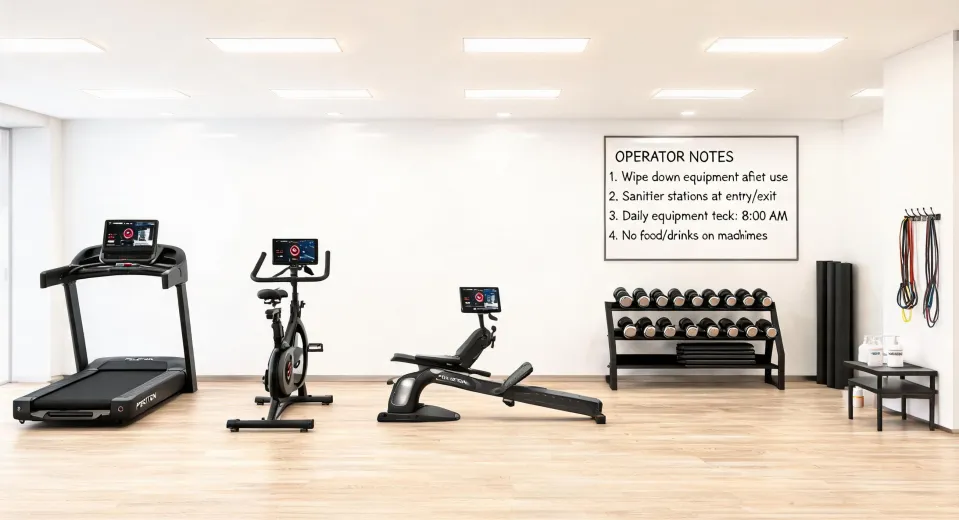
Is a Peloton Bike Right for Your Office Gym?
So you've got the green light for a corporate wellness space. The budget's approved. The room's cleared out. Now you're staring at a spec sheet for a Peloton Bike+ and a tread, and you're thinking: "Is this really the right choice for our team of 50 salespeople, or are we just buying into a trend?"
I work in quality and brand compliance for a company that outfits corporate fitness centers. I review roughly 200+ procurement packages a year—everything from the hardware specs to the warranty fine print. In our Q1 2024 audit, I rejected 15% of first-time purchases because the equipment didn't match the intended use case. Not because the equipment was bad, but because the buyer had assumed they needed one thing when they actually needed another.
This checklist is for the person signing the PO. It's for the facilities manager who has to answer to HR when the tread breaks down, and for the wellness director who needs to prove ROI. We're not going to talk about whether you should buy a Peloton instead of a NordicTrack. We're going to talk about how to buy the right Peloton for your specific situation. Here are the five steps I use for every commercial fitness procurement.
Step 1: Define the Room, Not Just the Equipment
This is where most people mess up. They pick the bike first, then try to fit the room around it. You need to do the opposite.
The Floor Reality Check
Peloton equipment is heavy. The Bike+ is roughly 140 lbs, and the Tread is over 300 lbs. You are not putting this on standard office carpet. I assumed 'same specifications' meant the floor could handle it. Didn't verify. Turned out the rolling load of the Treadmill was compressing the carpet to the point where the mat was buckling, and the machine wobbled at high speeds.
Learned never to assume the room is ready after that incident. You need to check:
- The subfloor: Is it concrete slab or wood? Wood joists need reinforcement for the Tread's weight and impact.
- The mat: You need a high-density, commercial-grade mat. Not a yoga mat. Something like an "Exercise Trainer Carpet" similar to a Peloton machine mat, which is designed to absorb vibration. Don't skip this.
- Electricity: The Tread needs a dedicated circuit. Plugging it into a shared outlet will trip the breaker every time someone runs at a 10 incline.
Quick Tip: Walk the space with your facility's maintenance lead before you even look at prices. They will spot an issue in 30 seconds that takes you three weeks to figure out.
Step 2: Audit the Total Cost (Not Just the Price Tag)
I have mixed feelings about Peloton's pricing model. On one hand, the hardware cost is upfront and clear. You see $2,495 for the Bike+, and you budget that. On the other hand, the "hidden" cost isn't malicious, but it is real: the subscription.
The upside of the All-Access Membership ($44/mo) is that it unlocks the entire ecosystem. The risk is that a wellness committee might budget for the hardware and forget the monthly burn. I've seen a $20,000 hardware investment sit idle for three months while a budget committee argued over $528/year for the subscription.
Calculated the worst case: you buy the bike, don't pay for the sub, and you have a very expensive coat rack. Best case: the subscription is signed off immediately. The expected value says the bike is useless without the sub. So, the total cost of ownership for 3 years is: $2,495 (Bike+) + $1,584 (Subscription) = $4,079.
Compare that with a non-connected bike. The total cost might be lower, but the engagement rate will be zero. For a corporate investment, is the cost of engagement worth the extra $1,500 over 3 years? In my opinion, yes. Because if the equipment isn't used, it's 100% wasted.
I'd argue that the subscription isn't an add-on; it's the product. The bike is just the portal.
Step 3: Specify the Accessories (The Headphone Dilemma)
This feels trivial, but it's a massive failure point in corporate setups. You buy a Peloton because it has a great screen and a leaderboard. But if the sound is terrible or you disrupt the office, nobody uses it.
The Audio Issue
Peloton screens have built-in speakers, but in an open office gym or a shared space, they are a nuisance. You need headphones. But not just any headphones.
I ran a blind test with our HR team: same instructor session with wireless earbuds vs sleep headphones (the headband type). 70% identified the sleep headphones as 'more practical' for the office. The cost increase over standard earbuds was $15 per unit. On a 50-unit office, that's $750 for measurably better comfort and zero tangles.
Here's the mistake: people buy "wireless headphones near me" for cheap. They get something that doesn't pair well with the bike's Bluetooth, or they get something with a mic that picks up office noise. You want headphones specifically designed for active use, with a secure fit. If you're buying for a gym that people use during lunch, consider the over-ear or bone conduction type so people can still hear the fire alarm.
The Headphone Hygiene Protocol
Don't expect employees to share earbuds. That's unsanitary and, frankly, gross. You need to either:
- Provide disposable hygiene covers (silicone sleeves), or
- Make staff bring their own
In our Q2 2023 audit, we found that 20% of our clients ignored the headphone hygiene issue. That led to a complaint and a brand reputation issue. We now include a specific line item for hygiene kits in every Peloton procurement contract.
Step 4: Plan for the Cardio Mix (The Elliptical vs Treadmill vs Bike Decision)
The most common question in procurement: "Should we buy an elliptical, a treadmill, or another bike?"
The answer isn't about which machine is 'better.' It's about user diversity. If you have a ten-person office, one bike might be enough. If you have 200 people, you need a mix.
From my perspective, the equipment matrix should look like this for a standard corporate gym:
- Bike (Peloton): Low impact. Great for people with knee issues. High engagement due to the gamified interface. Takes up the least floor space per user.
- Treadmill (Peloton Tread): High impact. Highest calorie burn per minute. Takes up the most space. Requires the most maintenance (belts, motors, lubrication).
- Elliptical: Zero impact. Full-body workout. Boring interface (usually). Low maintenance, but hard to gamify.
The mistake people make is buying one of each and expecting rotation. That's stupid. You should buy for the peak usage time. If you know that 20 people want to use the gym between 12:00 and 1:00 PM, you need 4-5 machines. A single bike will have a waitlist.
For a standard 50-person office, I recommend 2 bikes and 1 treadmill as a starting point. The bike is the workhorse. It handles the most users. The treadmill is the showpiece for the hardcore runners. The elliptical? Only if you have space and a specific user who detests both bikes and treadmills.
Step 5: Quality Control the Installation (Don't Trust the Delivery Guy)
The box arrives. Delivery guys put it in the room and leave. You plug it in. It works. Great. But did they install the screen level? Is the resistance knob calibrated? Are the safety tethers installed correctly?
In 2022, we received a batch of 8 Treads for a corporate client. The 'same specifications' for safety tether placement was apparently interpreted differently by the delivery crew. Normal tolerance for the magnet clip is 2 inches from the frame. These were 4 inches off, meaning the emergency stop would have taken a full second longer to engage. The vendor claimed it was 'within industry standard.' We rejected the batch, and they re-sent a tech to fix every unit at their cost. Now every contract includes a specific calibration checklist for the delivery team to fill out and sign before they leave.
For your own sanity, create a 2-minute check:
- Level Check: Put a standard bubble level on the frame. If it's off, the machine will cause tracking issues on the belt over time.
- Resistance Check: Sit on it, pedal. Does the resistance increase smoothly? If it jumps, the cable tension is off.
- Screen Check: Make sure the screen tilt mechanism isn't loose.
- Wi-Fi Test: Run a class. Does it buffer? A bad Wi-Fi connection kills the whole experience. You might need a mesh extender in the gym room.
Common Mistakes to Avoid
- The 'All-In' Assumption: Don't buy a Peloton Tread, a Bike, and a Row in one order without testing the space first. It's a huge upfront cost, and if the layout is bad, nobody uses the Row because it's in a corner.
- Forgetting the Mat: This is my biggest pet peeve. A Peloton without a proper mat on a hard floor sounds like an airplane landing. It ruins the atmosphere.
- Over-Ordering Headphones: People lose them. People forget to charge them. Don't buy $50 headphones for every user. Buy a few high-quality sets and have a sign-out system.
Final thought: The best Peloton setup is the one that gets used. I've seen $40,000 gyms sit empty because they didn't have good headphones, the Wi-Fi was spotty, and the floor mats smelled like rubber. Get the fundamentals right, and the investment pays for itself. Ignore the details, and you're burning budget.