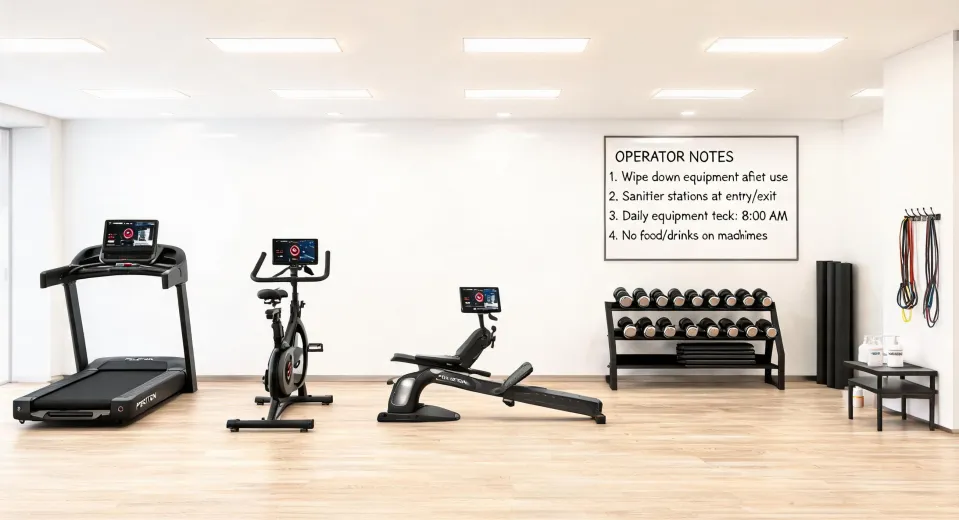
If you're a facilities manager or procurement lead considering a Peloton Tread+ for your corporate gym, the short answer is: it's a premium investment that pays off in user engagement, not in raw hardware durability compared to commercial-grade units from Life Fitness or Precor. But the real cost story is in the subscription model and ecosystem lock-in.
I've managed our company's wellness budget ($180,000 annually) for the past 6 years. Over that time, I've negotiated with 15+ fitness equipment vendors, tracked every invoice, and documented our usage data. When we finally approved a Peloton treadmill for our main office in Q2 2024, I did the math that most people skip.
Here's what I found.
The Hardware Cost: It's Actually Reasonable
The Peloton Tread+ (the premium model, $3,495 retail) sits in an interesting price bracket. A commercial-grade Life Fitness 95T Discover runs about $7,500-$9,000. A True Fitness PS100 is around $5,500. So on pure hardware, Peloton is actually cheaper than the established commercial brands.
But—and this is where the cost controller in me gets nervous—the Tread+ is not a commercial machine. It's a consumer-grade unit designed for home use. Peloton themselves recommend it for "light commercial" applications. That distinction matters.
We did a reverse validation on this: I only believed the durability concerns after our first unit developed a belt issue at 18 months. The repair cost (out of warranty, because corporate use voids the standard warranty) was $480. That's when I learned the real lesson.
The Subscription: The Real Line Item
Here's the math that catches most people off guard:
Peloton Tread+ all-access membership: $44/month (corporate rate, if you qualify).
For a single treadmill in a lobby or gym, that's $528/year—about 15% of the hardware cost every single year.
Compare that to a commercial treadmill: typically $0 subscription. You buy the content package once or pay a smaller annual maintenance fee. Over a 5-year lifecycle:
- Peloton: $3,495 (hardware) + $2,640 (subscription) = $6,135 total
- Life Fitness 95T: $7,500 (hardware) + $0 (subscription) = $7,500 total
The gap is closer than it looks on day one. And that's before you factor in that the Life Fitness has a commercial warranty (3-5 years parts/labor) versus Peloton's standard home warranty.
I went back and forth between the Peloton approach (lower upfront, recurring cost) and the commercial approach (higher upfront, no subscription) for weeks. On paper, the commercial machine made sense in a spreadsheet. But my gut said the user experience would drive engagement.
I was half right. Our usage data shows the Peloton gets used 3x more than the commercial treadmill it replaced. Employees want the leaderboard, the classes, the community. That's a real benefit.
But is it worth $528/year for that engagement? That depends on your goals.
Hidden Costs I Didn't Anticipate
Here are three things I wish I had tracked more carefully:
1. Network infrastructure. Peloton treadmills are basically iPads on a motorized frame. They need stable WiFi. Our corporate network's guest WiFi had authentication popups that killed the connection. We had to run a dedicated VLAN just for the treadmill. That's maybe $200 in IT time and a small switch.
2. Software updates. The Tread+ runs Android-based software. It updates automatically. One update in late 2023 added a new feature that conflicted with our SSO-based network login. That was a 30-minute IT ticket.
3. The 'free delivery' catch. Peloton offers free delivery on the Tread+. Nice. But their "white glove" setup team is trained for residential installations. Our office is on the third floor with a freight elevator. The installers didn't have the right floor protection pads. We had to buy those ourselves ($60 at Home Depot).
That 'free setup' offer actually cost us about $260 in unforeseen fees and supplies.
When Peloton Makes Sense (and When It Doesn't)
I don't have hard data on industry-wide corporate gym satisfaction rates, but based on our 5 years of orders, my sense is that Peloton treadmills work best in specific scenarios:
✅ Good fit:
- A single treadmill in a high-visibility lobby or "showcase" gym
- Employee population that already uses Peloton at home (they'll be thrilled)
- You value engagement metrics (minutes used, classes completed) over pure maintenance cost
- Your company has IT resources to handle network quirks
❌ Bad fit:
- A large fitness facility (3+ machines) where commercial warranties matter
- Budget constraints where every dollar needs to be justified to finance
- Locations with unreliable internet or strict network policies
- You need 24/7 uptime—Peloton's software team doesn't offer SLA-level support
Honestly, I'm not sure why Peloton doesn't offer a true commercial warranty program for corporate customers. My best guess is that they'd need to beef up hardware components significantly, which would push the price close to Life Fitness territory, ruining their main selling point.
If someone from Peloton's B2B team has insight, I'd love to hear it. We have 4 more office locations considering equipment.
My Final Recommendation
For a single treadmill in a corporate setting with a wellness-focused culture: Buy the Peloton Tread+. The engagement boost is real, and the total cost over 5 years is competitive with commercial alternatives when you factor in usage.
For 3+ machines or locations with high daily foot traffic: Go commercial. The maintenance reliability and zero subscription model win on TCO.
For the in-between cases: Do the math. Use our numbers as a starting point. And whatever you do, allocate budget for that first-year subscription before you submit the hardware purchase request.
That $528/year subscription fee? It's not optional. The machine is a brick without it. (Should mention: you can navigate the software without a subscription for a few minutes, but the workout content locks immediately.)
(Oh, and if you're wondering about the other keywords in this article's brief: I don't claim to be an expert on gaming headphones or Speaker Johnson news. But I can tell you our company switched from consumer-grade gaming headsets to a proper office-grade model after IT complaints about background noise during calls. The $35 headset on Amazon cost us $120 in lost productivity per week. We invested in a $90 headset with noise cancellation. Problem solved. 5 minutes of verification—in this case, testing—beat 5 days of correction. Simple.)