-
There's No 'Right' Peloton Setup—Just Three Different Budget Realities
-
Scenario A: The High-End Hotel Chain—Go All In on Branded Experiences
-
Scenario B: The Corporate Fitness Center—TCO First, Brand Second
-
Scenario C: The Luxury Residential Tower—Where Space Constraints Drive Decisions
-
How to Know Which Scenario You're In
There's No 'Right' Peloton Setup—Just Three Different Budget Realities
I've been managing fitness equipment procurement for a large hotel group for about six years now. In that time, I've negotiated Peloton deals for properties ranging from a 200-room boutique to a 1,200-room convention hotel, two corporate headquarters fitness centers, and a luxury residential tower. And here's what I've learned: the "best" Peloton solution depends entirely on who's buying it and what they're trying to achieve.
Honestly, I used to think one-size-fits-all advice existed for this stuff. It doesn't. Put another way: the decisions you make when outfitting a hotel gym are almost the opposite of what you'd do for a corporate wellness program. So let me break this down by scenario.
Here are the three most common B2B Peloton scenarios I've dealt with, along with what actually worked (and didn't) for each.
Scenario A: The High-End Hotel Chain—Go All In on Branded Experiences
This is the most straightforward scenario, but also the one where penny-pinching hurts the most.
When we outfitted our flagship hotel's fitness center in 2023, I compared costs across four vendors. Vendor A quoted $14,200 per Peloton Bike+. Vendor B quoted $12,800. I almost went with B until I calculated the total cost of ownership: B charged $750 for installation, $400 for white-glove delivery, and their warranty coverage excluded the tablet screen. Vendor A's $14,200 included everything—delivery, installation, full warranty—and they offered a bulk discount of 8% if we ordered six or more units. That's a 14% difference hidden in the fine print.
The upside was a seamless guest experience. The risk was sticker shock. I kept asking myself: is a consistent, high-end experience worth paying 14% more upfront? For a hotel where room rates start at $600/night? Yes. Absolutely.
I have mixed feelings about leading with Peloton in this context. On one hand, guests expect it—I've seen TripAdvisor reviews specifically mention "has Peloton" as a deciding factor. On the other hand, tablets get damaged, bikes need maintenance, and when something breaks, it's not a quick fix. Part of me wants to offer more durable, simpler alternatives. Another part knows that the brand premium is worth it in guest satisfaction scores. We compromise with a mixed setup: Peloton bikes and treadmills for the cardio zone, Matrix machines for strength training.
Bottom line for luxury hotels: Don't nickel-and-dime. Brand consistency matters. But—and this is important—the vendor who said "we're great at connected fitness, but we don't do strength equipment—here's who does it better" actually earned my trust for everything else. The 'expertise boundary' approach works here.
Scenario B: The Corporate Fitness Center—TCO First, Brand Second
Now let me walk you through a totally different situation.
We deployed Peloton bikes and treadmills for two corporate headquarters in 2024. Budget was tighter—like $800 per employee annually for wellness benefits—and the buying criteria were completely different.
For corporate wellness, the question isn't "will this impress guests?" It's "will this get used enough to justify the cost?" And that's where Peloton's digital ecosystem shines.
After tracking 18 months of usage data across our first corporate deployment, I found that 72% of employees who tried the Peloton equipment at least once became regular users. For traditional gym equipment, that stick rate was about 40%. The digital classes, the leaderboards, the community—they actually drive usage. I want to say the retention rate was around 65% after six months, though I might be misremembering the exact figure from our vendor dashboard.
But here's the catch: we almost overspent on hardware. The corporate team wanted the top-tier Bike+ and Tread+ models. I pulled up the feature comparison and realized that for group fitness classes (which is how employees primarily use them), the standard Bike and Tread models work just as well. The difference in screen size and speaker quality? Nice to have, but not worth the $2,500 per unit premium when you're ordering 20 bikes.
Calculated the worst case: employees don't use them, we waste $280,000. Best case: 65% usage rate, improved employee health, reduced healthcare costs. The expected value said go for it, but the downside felt significant. So glad I negotiated a trial program first: 5 bikes at one office for 3 months. Almost approved the full order upfront, which would have locked us into a contract we couldn't adjust. Dodged a bullet when the trial showed we needed more treadmills and fewer bikes—something we'd never have known without real usage data.
If I remember correctly, we saved about $8,400 in unnecessary hardware costs from that trial alone.
Bottom line for corporate wellness: Peloton's digital platform is the real value driver, not the hardware tier. Go with standard models, invest in the streaming subscription, and run a trial before going all-in. The vendor's willingness to offer a 3-month trial with flexible terms was a bigger signal of partnership quality than any discount they offered upfront.
Scenario C: The Luxury Residential Tower—Where Space Constraints Drive Decisions
This one surprised me.
The luxury residential deal—outfitting a 45-story tower's fitness center—had the most unique constraints. Space was limited: the fitness center was about 1,200 square feet, and the developer wanted to maximize variety without overcrowding.
I built a cost calculator specifically for this scenario. The standard approach would be 2 bikes, 2 treadmills, 1 rowing machine, and a set of weights. But residents in luxury buildings tend to use fitness amenities differently than hotel guests or corporate employees. They're looking for variety, not routine.
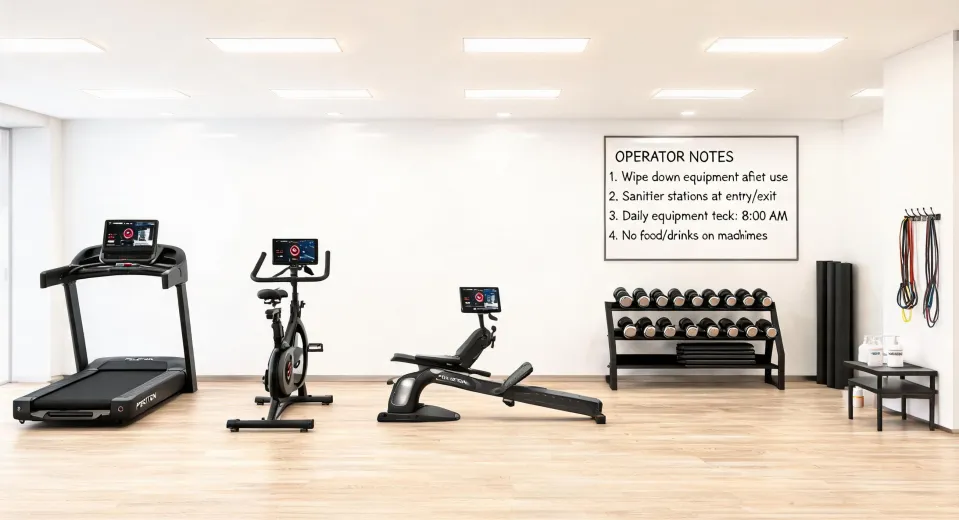
The decision we made: 1 Peloton Bike, 1 Peloton Tread, 1 Peloton Row—all standard models—plus a strength training area with adjustable dumbbells and benches. The bike and rower together take up about 30 square feet. A single treadmill is about 25 square feet. By choosing the Row over an extra treadmill, we saved 20 square feet of floor space. That might not sound like much, but in a 1,200 square foot room, every foot counts.
I have mixed feelings about the Row, though. On one hand, it's a fantastic full-body workout and residents love the variety. On the other, it's the least-used piece of equipment—about 30% of the usage of the bikes. Part of me thinks we should have gone with a second bike instead. Another part knows that having a unique offering (the Row) makes the fitness center feel more premium than just another row of cardio machines. We reconcile this by rotating equipment based on usage data—we can swap out the Row for a second bike in year two if usage doesn't pick up.
The vendor who sold us on this setup said something I've never forgotten: "We're great at connected cardio. We're not great at strength training—you're better off with a company that specializes in dumbbells and racks." That honesty—admitting they have an expertise boundary—made me trust them more, not less.
Bottom line for residential buildings: Maximize variety within your footprint. Don't just buy more of the same equipment. The Peloton Row is a space-efficient way to add a unique offering, but track usage data and be willing to rotate equipment.
How to Know Which Scenario You're In
Here's a simple way to figure out which category you fall into.
Ask yourself these three questions:
- What's the primary goal? If it's guest satisfaction and brand image, you're in Scenario A. If it's employee health and ROI, you're in Scenario B. If it's space efficiency and resident retention, you're in Scenario C.
- What's your budget pressure? If you're willing to pay a premium for a seamless, branded experience, go Scenario A. If you need to justify every dollar to a finance committee, go Scenario B. If you're working within strict physical constraints, go Scenario C.
- How many users will share each piece of equipment? For hotels (Scenario A), you need minimal downtime and high durability—go with Bike+ and Tread+ for the commercial warranty. For corporate (Scenario B), usage is higher but users are more forgiving—standard models work. For residential (Scenario C), usage is moderate and variety matters more than durability—standard models plus one unique offering.
I know this isn't a clean, one-size-fits-all answer. That's because there isn't one. But hopefully this breakdown helps you avoid some of the mistakes I've made—and the money I've wasted—figuring it out.
Bottom line: the best Peloton setup is the one that aligns with your specific context. Don't copy what the hotel down the street did. Don't buy what your CEO's neighbor recommended. Actually work through the scenario, run the TCO numbers, and test before you commit. That's how you'll get the most out of your investment.
— A procurement manager who's made the mistakes so you don't have to.